
D.O.J. Hands Trump, His Family and Businesses Immunity From Tax Investigations
Alan Feuer, Andrew Duehren and Glenn Thrush The New York Times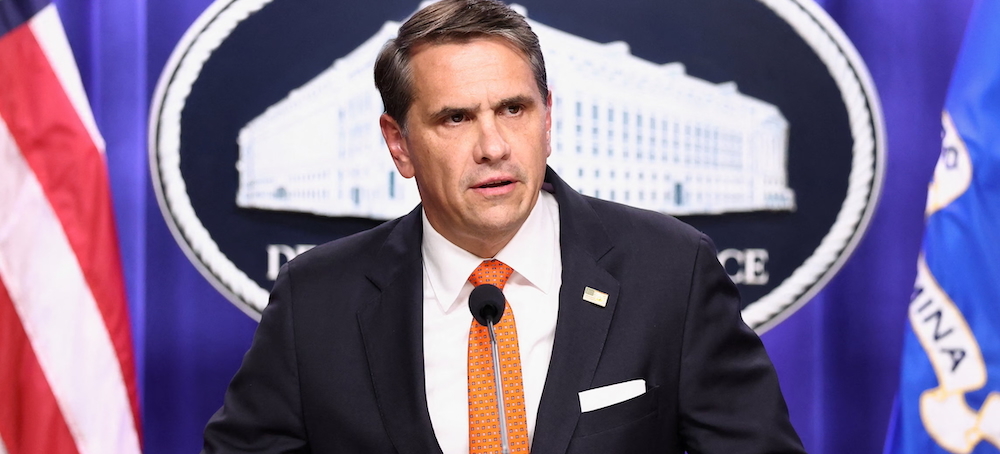 Acting Attorney General Todd Blanche. (photo: Reuters)
 D.O.J. Hands Trump, His Family and Businesses Immunity From Tax Investigations
Alan Feuer, Andrew Duehren and Glenn Thrush The New York TimesALSO SEE: Trump and Sons to Be ‘Forever’ Exempt From Tax Audits
As part of the Justice Department’s deal, officials vowed not to pursue any matters, including those involving President Trump’s tax returns, that are pending.
The provision, quietly inserted on Tuesday as a supplement to a remarkable deal that also created a $1.8 billion fund aimed at benefiting Mr. Trump’s allies, protects the president, his relatives and his businesses from pending audits and tax prosecutions.
The one-page document, signed by the acting attorney general, Todd Blanche, said that the government would be “FOREVER BARRED and PRECLUDED from prosecuting or pursuing” pending tax claims against Mr. Trump, his family members and businesses.
The provision invited immediate criticism as tax experts raised the possibility that it was illegal.
That the addendum to the deal was posted, without fanfare, on the department’s website belied its bare-knuckled audacity. It revealed the determination of Mr. Trump and his appointees to ram through maximalist measures with minimum outside scrutiny at a moment when they still have uncontested control of government.
The provision was the latest in a series of maneuvers this week that blurred the all-but-vanished boundary between official department business and the private interests of a president intent on using his power to extract financial gain from the federal government for himself and his allies.
A day earlier, Mr. Trump agreed to drop his $10 billion lawsuit against the I.R.S. in exchange for the establishment of a fund for people he believes were wronged by federal investigations or prosecutions.
Justice Department officials had in part defended the creation of the fund by pointing to the fact that Mr. Trump and his family members would not be paid by it.
But protection from audit could be quite financially beneficial for Mr. Trump, who has always said that there was no wrongdoing in his tax filings. In 2024, The New York Times reported that a loss in an I.R.S. audit could cost Mr. Trump more than $100 million.
It is unclear if that examination has concluded or if Mr. Trump, his family members or affiliated entities are under other audits. I.R.S. procedures call for the mandatory audit of the president’s tax returns annually.
Neither the Justice Department nor the I.R.S. responded to requests seeking comment. The top lawyer at the Treasury, Brian Morrissey, resigned on Monday after the Justice Department announced the deal with Mr. Trump.
Federal law prohibits the president, vice president and other executive officers from instructing the I.R.S. to start or stop specific audits. But that broad prohibition appears to include a carve out for the attorney general.
Brandon DeBot, a senior attorney adviser at New York University’s Tax Law Center, said in a statement that the audit protection may still be illegal.
“The I.R.S. would need to act to make the release of claims effective, which could raise additional questions about whether there has been unlawful political interference in the audit process,” he said. “The settlement and general release of claims is a breathtaking abuse of the tax and legal system.”
The disclosure of the provision came as blowback appeared to be mounting over the creation of the fund, including from a few Republican lawmakers typically wary of incurring Mr. Trump’s wrath.
Senator John Thune, Republican of South Dakota and the majority leader, offered rare criticism of the president, saying he “was not a big fan” of the fund and adding that he did not see a “purpose” to it.
The Times reported last week that Mr. Trump’s talks with the Justice Department and the I.R.S. had included a measure calling on the I.R.S. to drop any audits of the president, his relatives or businesses. But that provision did not appear in the nine-page agreement laying out the terms to dismiss the lawsuit, which the department released on Monday.
In January, Mr. Trump, along with two of his sons and the Trump family business, sued the Internal Revenue Service for at least $10 billion over the leak of their tax returns during the president’s first term. The Trumps argued that the I.R.S. should have done more to prevent a former contractor from disclosing tax information to The New York Times and ProPublica.
Even as the original nine-page agreement offered scant details of how disbursement would work or who would be eligible, it said that claimants could seek money from the government for having faced reprisals for “personal, political and/or ideological reasons.” It stated that a five-person commission would consider claims based on criteria like damages a person had incurred or any time they spent in federal custody.
The main agreement also indicated that claims would largely be handed out in secrecy, requiring the fund managers to provide the attorney general on a quarterly basis with a “confidential written report” of those who received any money. The fund would stop processing claims no later than Dec. 1, 2028, just weeks before Mr. Trump is scheduled to leave office.
Frank Bisignano, the chief executive of the I.R.S., signed the original, nine-page deal. The provisions granting Mr. Trump immunity from existing audits, though, was signed only by Mr. Blanche, who has stepped up carrying out Mr. Trump’s campaign of retribution against his enemies.
During an appearance before a Senate appropriations subcommittee on Tuesday, Mr. Blanche defended the fund.
At one point, Senator Chris Van Hollen, Democrat of Maryland, repeatedly accused Mr. Blanche of behaving more like a Trump defense lawyer than an independent guardian of the public interest.
Mr. Blanche pushed back, asserting that he was “the acting attorney general.”
Mr. Van Hollen replied, “Mr. Attorney General, you are acting today like the president’s personal attorney, and that’s the whole problem.”