
Do Trans People Have “Stand Your Ground” Rights? Wyoming’s Answer May Be “No.”
Caroline E. Light Slate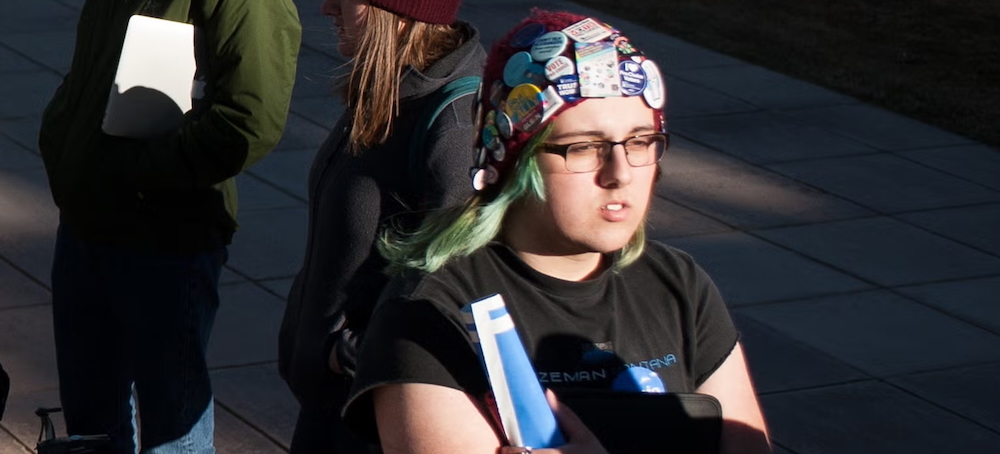 Rihanna Kelver in 2016. (photo: Theo Stroomer/Getty Images)
 Do Trans People Have “Stand Your Ground” Rights? Wyoming’s Answer May Be “No.”
Caroline E. Light SlateKelver responded by drawing a pistol from her bag, chambering a round, and pointing the weapon at the man who had pushed her. She kept the safety on and never fired. The man and his companions retreated.
Today, Kelver, a 28-year-old trans woman, faces two felony charges—aggravated assault and possession of a deadly weapon with unlawful intent—that could carry up to 15 years in prison. The man who shoved Kelver and who allegedly initiated the confrontation, known only as “S. Durham,” has not been charged.
According to Wyoming Statute Section 6-2-602, people who are lawfully present do not have to try to retreat before using force to protect themselves from imminent death or serious bodily harm. This “stand your ground” law echoes statutes in 29 other states: They remove the duty to retreat, allowing a person to use defensive force as long as they are not the initial aggressor. Kelver’s attorney argues that she acted squarely within state law. The aggravated assault statute under which she was charged exempts situations in which displaying a firearm is “reasonably necessary” for self-defense. Video evidence confirms that Kelver was alone, outnumbered, physically assaulted, and left on the ground facing multiple aggressors.
But Albany County Circuit Court Judge Robert Sanford, who presided over Kelver’s pretrial hearing, agreed with the prosecutor that there was probable cause that she committed the crimes with which she was charged. Kelver must now argue her case in court, risking up to 15 years in prison if she cannot convince a jury that she was acting reasonably in self-defense. Cases like Kelver’s expose key contradictions at the heart of our cherished rhetoric of armed self-defense. The legal right to defend oneself has always proved far more fragile when exercised by the very people who most need protection.
For generations, our nation’s reigning political culture has celebrated armed self-defense as a fundamental right. In recent years, many states—with the blessing of the Supreme Court—have moved aggressively to expand “gun rights,” eliminating permit requirements, loosening restrictions on firearm carry, and framing armed self-defense as an essential expression of individual liberty and good citizenship. Wyoming has joined that movement, passing its “stand your ground” law in 2018 and adopting “constitutional” (aka permitless) carry in 2021.
In many ways, Kelver’s case echoes another one involving a person shoving another to the ground, and the latter brandishing a firearm. In July 2018, 28-year-old Markeis McGlockton took his young son into a Clearwater, Florida, convenience store to purchase snacks. His girlfriend, Britany Jacobs, idled their car in a disabled parking spot, accompanied by the couple’s other child. Upon hearing a commotion outside, McGlockton left the store to see 47-year-old Michael Drejka arguing heatedly with Jacobs. Fearing for his family’s safety, McGlockton shoved Drejka to the ground, and the latter pulled out his handgun.
McGlockton started backing away, but, unlike in Kelver’s case, Drejka fired his gun, striking McGlockton in the chest.
Markeis McGlockton died in front of his family, and Drejka—a white man—claimed that he had acted in self-defense, and that he was in “fear for his life” from the larger, younger Black man. The sheriff did not charge Drejka initially because of Florida’s “stand your ground” statute, which protects an individual’s right to use deadly force if they reasonably believe that their life is in danger.
The case pitted McGlockton’s right to defend his family from a threatening stranger against Drejka’s right to initiate a confrontation over a parking spot and to mete out justice according to his own whim. Due in large part to the release of video footage showing McGlockton starting to back away, Drejka was eventually charged with manslaughter. He was found guilty the year following the incident and is serving a 20-year sentence.
Unlike Drejka, Kelver did not fire her gun, nor did she initiate the confrontation, yet she was not given the benefit of the doubt by local authorities.
Kelver’s experience also fits a long and troubling history of transgender people being punished for their acts of survival. In 2011, Cece McDonald, a Black trans woman in Minnesota, defended herself with a pair of scissors during a racist and transphobic attack. One of her assailants died in the altercation that he initiated. Although evidence indicated that McDonald had been attacked first, she ultimately accepted a plea deal and served 19 months in a men’s prison.
In the same year, Ky Peterson, a young Black trans man in Georgia, shot and killed his rapist. Peterson was sentenced to 20 years and served nine. In each case, the legal system could not recognize the urgent need for protection experienced by people disproportionately targeted for harassment and violence. It is for this reason that transgender people who survive violence often find themselves transformed from victims into suspects—especially if they are nonwhite and/or low-income. Our legal system seems well prepared to scrutinize and punish their acts of self-preservation instead of examining the circumstances that made those acts necessary.
This dynamic is especially striking in Kelver’s case because it collides with another deeply American mythology: that the Second Amendment operates as a universal guarantee for everyone.
Gun rights advocates often describe firearms as the “great equalizer”: A firearm allows a smaller person to defend themselves against a larger attacker; it protects vulnerable individuals who cannot rely on immediate police intervention; it gives ordinary people the means to survive dangerous encounters.
If we accept the great-equalizer premise, then Kelver appears to be a textbook example of the iconic armed citizen endowed with Second Amendment rights. She is a well-trained and responsible gun owner. According to the Laramie Reporter, she was carrying a pistol because she had previously experienced threats from a co-worker. On the night in question, she was physically assaulted by a large man and outnumbered by his companions. And unlike Michael Drejka, she brandished her gun without discharging it. By all accounts, Kelver’s perception of threat was reasonable, which—by Wyoming law—should exempt her from criminal prosecution.
The logic deployed against Kelver is ultimately about much more than her individual claim to “keep and bear” arms for her self-defense. It is about the ways our legal system creates categories of people whose claims to self-defense are treated as ephemeral. Once we decide that some citizens must clear a higher bar before they are permitted to protect themselves, rights stop functioning as rights. They become permissions granted or withheld based on the whims of those who interpret and adjudicate our laws.
Historically, that logic has never remained confined to a single group. Black and Indigenous Americans, labor organizers, immigrants, queer people, political dissidents, abuse survivors, and countless others have discovered that rights celebrated in the abstract can evaporate when exercised against the wrong forces.
At this moment, these forces include a federal government that has turned increasingly against its people while vitiating the rule of law, labeling everyone who resists “violent secular political groups whose ideology is anti-American, radically pro-transgender, and anarchist.”
In this light, the questions raised by Kelver’s case stretch beyond whether she should ultimately prevail at trial.
It is whether we all genuinely possess a right to stand up and defend ourselves from injustice and violence, or whether this right inheres only in certain kinds of people, the ones favored by those in power.