
Displaced Stream Back to South Lebanon as Uncertain Ceasefire Takes Hold
Mohamad El Chamaa, Steve Hendrix and Susannah George The Washington Post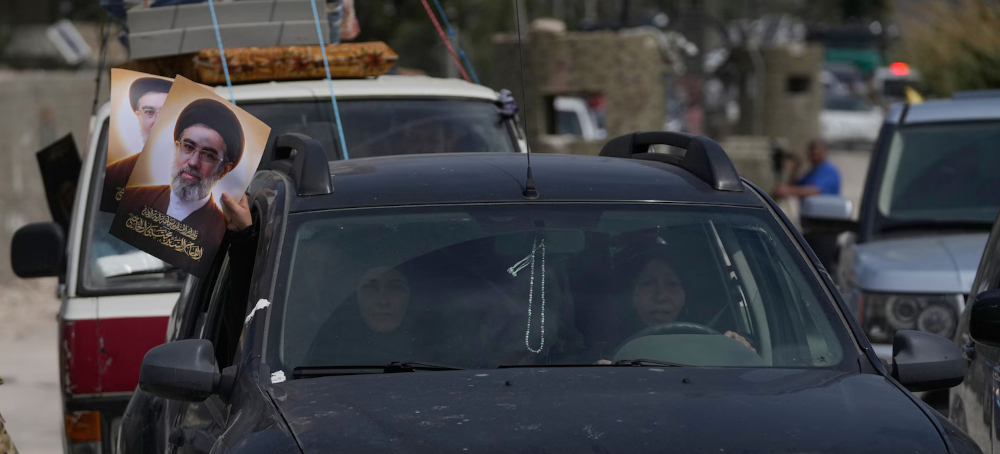 Displaced women hold portraits of Iran's supreme leader, Ayatollah Mojtaba Khamenei, as they return to their village in south Lebanon on Friday. (photo: Mohammed Zaatari/AP)
 Displaced Stream Back to South Lebanon as Uncertain Ceasefire Takes Hold
Mohamad El Chamaa, Steve Hendrix and Susannah George The Washington PostALSO SEE: Israel and Lebanon Reach Deal on a 10-Day Cease-Fire
Even amid uncertainty over whether Hezbollah would uphold the truce, Lebanese residents expressed relief at the prospect of quiet, and aid groups were mobilizing help.
Displaced civilians crowded roads leading back into regions that have been hammered in fighting between Hezbollah and Israel, hopeful they will get a respite but unsure of how stable the 10-day truce will be or whether Hezbollah, the Iranian-backed militant group, will honor it.
Hezbollah, which attacked Israel in retaliation for the killing in late February of the Iranian supreme leader, Ayatollah Ali Khamenei, has acknowledged the 10-day agreement was brokered in Washington between the Lebanese government and Israel. But the group was not a participant in the negotiations and has not committed to upholding the agreement.
President Donald Trump warned the group not derail the fragile ceasefire in a social media post early Friday: “I hope Hezbollah acts nicely and well during this important period of time,” Trump posted. “It will be [a] GREAT moment for them if they do. No more killing. Must finally have PEACE!”
Even amid the uncertainty, Lebanese residents expressed relief at the prospect of quiet. Relief agencies and religious groups mobilized to aid families on their return to battered towns.
“Today is a day of love and peace since this is the first day of the ceasefire,” Cardinal Béchara Boutros, who was traveling with a Vatican convoy to deliver 30 tons of humanitarian aid, told The Washington Post at a stop in this small Christian town in south.
Along the roadside, vendors had set up to sell Hezbollah flags to passing cars. The group had also unfurled fresh banners and flags along the route south — a visible effort to project strength and claim the ceasefire as a victory, even as the terms of the truce remained bitterly contested.
Some aspects of the Lebanon ceasefire deal remain uncertain. Lebanese President Joseph Aoun said Friday that his government would work to “secure the withdrawal of Israeli forces from the occupied southern territories,” according to a statement. Israeli Defense Minister Israel Katz said his forces would not withdraw.
The Israel Defense Forces “will continue to hold all the areas it has cleared and captured” in southern Lebanon, Katz said in a recorded statement Friday. Katz referred to a six-mile band of Lebanese territory along the Israeli border as a “buffer zone” and said it “has been cleared of terrorists and weaponry and is empty of residents.” He added: “It will continue to be cleared of terror infrastructure.”
Katz also called for southern Lebanon up to the Litani river to be demilitarized “either through diplomatic means or through the continuation of the IDF’s military activity at the end of the ceasefire.”
The Trump administration brokered the Lebanon ceasefire to build momentum behind the broader U.S.-Iran ceasefire, which is set to expire in five days, and to nudge stalled negotiations with Tehran, including over Iran’s nuclear program, toward a deal. The first round of talks in Islamabad, Pakistan, ended last weekend without agreement after 21 hours, with both sides accusing the other of moving the goalposts.