
DHS Shutdown Inching Closer as Funding Deadline Looms
Sophie Brams The Hill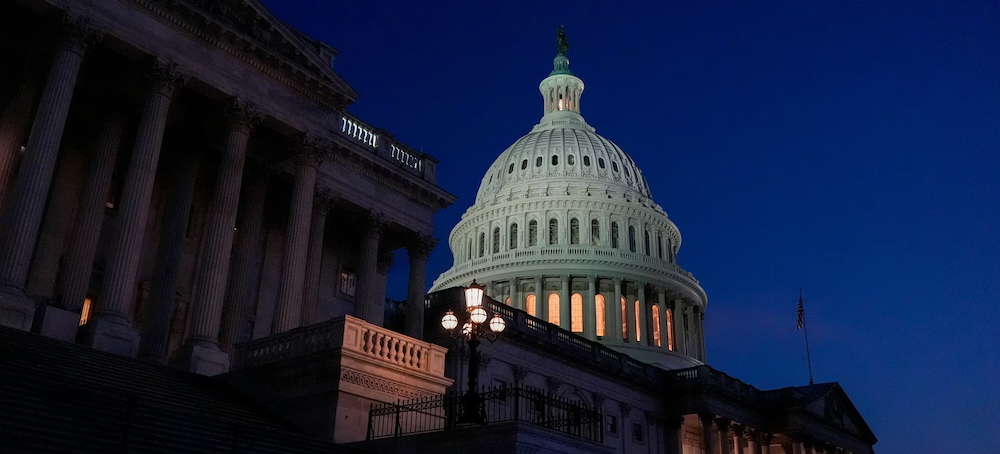 The United States Capitol building. (photo: Kent Nishimura/Bloomberg/Getty Images)
 DHS Shutdown Inching Closer as Funding Deadline Looms
Sophie Brams The HillA funding package passed earlier this week included a two-week stopgap measure for DHS, funding it at 2025 levels through Feb. 13. Lawmakers have until that deadline to strike a deal for the full-year 2026 bill, agree to another stopgap to buy more time to negotiate, or allow a shutdown that would affect a wide swath of agencies that fall under DHS’s purview.
Democrats are demanding reforms to how the Trump administration conducts immigration enforcement and have sent Republicans a series of demands, while also vowing not to support another short-term funding extension. Republicans are insisting most of those demands are “non-starters.”
Immigration and Customs Enforcement (ICE) and Customs and Border Protection (CBP) have come under intense scrutiny following the fatal shootings of two U.S. citizens, Alex Pretti and Renee Good, by federal agents in Minneapolis last month.
Negotiations thus far appear to have stalled, and senators on both sides of the aisle did not seem optimistic about avoiding a funding lapse heading into the weekend.
Senate Majority Leader John Thune (R-S.D.) was weary about the prospect of a deal emerging in the next week.
“We’ve got a — now — one-week-and-one-day time frame in which to do this, which is entirely unrealistic, and a Democrat Party in both the House and the Senate which seems a lot less interested in getting a solution to this than they do in having a political issue,” he said.
A DHS shutdown would have implications beyond immigration agencies, also bringing other federal agencies within the department to a halt, including the Transportation Security Administration (TSA), the Federal Emergency Management Agency (FEMA), the U.S. Coast Guard, and the Secret Service.
Concern about disrupting critical services, even temporarily, prompted several leading Democrats to propose passing a funding measure that would keep non-immigration-related parts of the government running while splitting off negotiations over ICE and CBP.
Republicans have dismissed the idea as unfeasible.
DEMOCRATS SEEK TO REIN IN ICE
Democrats have sought to rein in federal agents participating in Trump’s immigration crackdown, a push that recent polling suggests is gaining support among the public.
Democratic leaders laid out their demands for reform at DHS in a letter to Republican leadership on Wednesday, outlining ten “guardrails” they want to see included in the DHS funding bill.
Those demands will be at the center of negotiations this week over averting a DHS shutdown.
They include an end to “indiscriminate arrests,” a ban on DHS officers entering private property without a judicial warrant, expanded training requirements, and adoption of a standardized use of force policy.
Democrats also want agents to stay away from “sensitive locations,” such as schools and churches, identify themselves, use body-worn cameras, and stop wearing masks while conducting enforcement operations.
“Furthermore, there are steps that the Trump administration has the power to take right now to show good faith, including fully ramping down the surge in Minnesota and removing Secretary of Homeland Security Kristi Noem from her position,” House Minority Leader Hakeem Jeffries (D-N.Y.) and Senate Minority Leader Chuck Schumer (D-N.Y.) wrote.
Some Republicans have indicated a willingness to support a few of the proposals backed by their Democratic counterparts. Mandating body cameras, a plan already in the works, and ending roving patrols are two areas where there appears to be bipartisan agreement.
But many have drawn a hard line on the demand for unmasking agents, arguing that officers need face coverings to protect against targeted harassment, threats, and “doxxing.”
“The reason that ICE agents wear masks is to protect their own identities and protect their own families,” House Speaker Mike Johnson (R-La.) said in a Feb. 1 interview on NBC’s “Meet the Press.”
Republicans also want their own priorities in the legislation, specifically an end to so-called “sanctuary city” policies that they say undermine cooperation between local, state, and federal authorities.
Both Democrats and Republicans have accused each other of not negotiating in good faith.
“Democrat’s newest proposal is a ridiculous Christmas list of demands for the press. This is NOT negotiating in good faith, and it’s NOT what the American people want. They continue to play politics to their radical base at the expense of the safety of Americans,” Sen. Katie Britt (R-Ala.), the lead Senate GOP negotiator, wrote on X.
LEADERS OF ICE, CBP AND IMMIGRATION SERVICES TO TESTIFY BEFORE SENATE, HOUSE PANELS
All eyes will be on the House and Senate Homeland Security committees this week as the heads of the three major federal immigration agencies are set to testify amid growing concern over the handling of Trump’s mass deportation agenda.
Acting ICE Director Todd Lyons, CBP Commissioner Rodney Scott, and USCIS Director Joseph Edlow have agreed to appear before the House Committee on Homeland Security on Tuesday at 10 a.m. They are set to appear before a Senate panel on Feb. 12.
House Homeland Security Committee Chair Andrew Garbarino (R-N.Y.). and Senate Homeland Security Committee Chair Rand Paul (R-Ky.) called on the officials to testify late last month, citing Congress’ responsibility to conduct oversight into the large amount of money given to the agency.
DHS received $165 billion in Republican’s One Big Beautiful Bill Act signed into law by Trump last July, including $75 million to fund ICE through 2029.
“Congress have an obligation to conduct oversight of those tax dollars and ensure funding is used to accomplish the mission, provide proper support for our law enforcement, and, most importantly, protect the American people,” Paul wrote in a Jan. 26 letter formally requesting their presence.
The trio is likely to face a grilling from Democratic lawmakers, who are demanding accountability and greater transparency in the wake of deadly shootings in Minnesota.
Trump has signaled a “softer touch” may be needed on immigration and the administration pulled hundreds of agents out of the state last week in an attempt to contain the political fallout. Still, the White House has vowed to press on with its operations.
The House Judiciary Committee will also hold a key hearing on Wednesday with Attorney General Pam Bondi.
That hearing, set for 10 a.m., is focused on examining “the mission and programs” of the Justice Department, and is likely to feature questions about the latest batch of files released in connection with disgraced financier and convicted sex offender, Jeffrey Epstein.
VOTER ID BILL EXPECTED TO HIT HOUSE FLOOR
The House is expected this week to take up Rep. Chip Roy’s (R-Texas) Safeguard American Voter Eligibility Act — or the SAVE America Act — a bill that would require Americans to show photo ID when voting in federal elections and proof of U.S. citizenship to register, and mandate that states remove non-citizens from its voter rolls.
Republicans have framed the requirements as necessary to strengthen election security and prevent non-citizens from voting, despite available data showing it is a rare occurrence.
Critics have denounced the proposal as an attack on voting rights and warned it could disenfranchise millions of legal voters, disproportionately affecting rural and working class voters, as well as voters of color and older Americans.
Roughly 21.3 million U.S. citizens do not have proof of citizenship readily available, according to a June 2024 survey by the Brennan Center for Justice. The center said the bill would likely also create a barrier for millions of women whose married names do not match their birth certificates or passports.
The SAVE America Act is iteration of an earlier bill that passed the House twice, and Roy appears optimistic about its prospects a third time.
“Once the bill passes the House, Leader Thune must bring it to the Senate floor and force Democrats to explain why they oppose securing our elections,” Roy said in a statement, in part.
The legislation has stalled in the Senate amid staunch Democratic opposition, however. Senate Minority Leader Chuck Schumer (D-N.Y.), who has compared the proposal to “Jim Crow 2.0,” said in a Feb. 2 statement it would be “dead on arrival” in the upper chamber, signaling Democrats are likely to proceed with a filibuster.
“Let’s be clear, the SAVE Act is not about securing our elections. It is about suppressing voters. The SAVE Act seeks to disenfranchise millions of American citizens, seize control of our elections, and fan the flames of election skepticism and denialism,” Schumer said in a statement released by the Senate Democratic Caucus.
The bill has the backing of President Trump, who in recent days, has repeatedly called for nationalizing elections and suggested Republicans should “take over” voting in “at least 15 places.”