
Democrats Press for More Information About Newly Revealed Ballroom Donors
Jonathan O'Connell and Sarah Blaskey Washington Post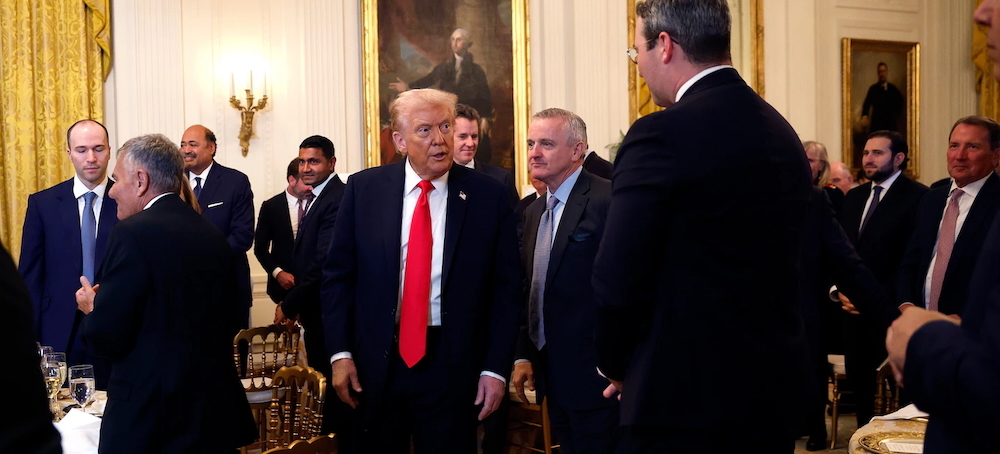 President Donald Trump greets guests during a ballroom fundraising dinner last week at the White House. (photo: Kevin Dietsch/Getty Images)
Democrats Press for More Information About Newly Revealed Ballroom Donors
Jonathan O'Connell and Sarah Blaskey Washington PostALSO SEE: Secret Documents Reveal Donors Behind $330 Million for Trump’s Ballroom
Sens. Richard Blumenthal (Connecticut) and Elizabeth Warren (Massachusetts) described the donations as a form of influence peddling.
Sen. Richard Blumenthal (D-Connecticut) on Tuesday wrote to 14 previously undisclosed donors asking for information about how their donations were solicited, whether anyone in the administration proposed a specific amount and why some of the donors elected to remain anonymous. The donations ranged from $100,000 to $25 million.
“The donations all have the appearance of pay-to-play because most of these corporations and individuals have issues before the federal government,” Blumenthal said in an interview Tuesday. “We want to know how the public interest may have been compromised by these donations.”
Blumenthal, the top Democrat on the Senate Permanent Subcommittee on Investigations, said he intends to investigate the ballroom fundraising more deeply if his party takes control of the Senate in the midterm elections.
“We’re clearly laying the groundwork for a broader and more intensive investigation with possible use of subpoena power,” he said.
The Post report revealed previously undisclosed contributors to the ballroom who have benefited under the Trump administration from regulatory decisions, government contracts and, in one case, a pardon for a family member.
Ordinary political giving requires public disclosure and is subject to campaign finance rules. The ballroom donations are collected by a nonprofit organization and then channeled to the government and into a White House account the president directly controls.
Independent experts and scholars have expressed alarm at the potential the arrangement has for influence buying and coerced giving.
In a statement for this story, White House spokesman Davis Ingle said: “The same critics who are alleging fake conflicts of interests, would also complain if American taxpayers were footing the bill for these long-overdue renovations.”
The donors Blumenthal sent letters to on Tuesday include Charlie Ergen, co-founder of EchoStar and Dish Network, as well as tech firms Cisco Systems, Salesforce and ServiceNow.
Among the others he requested information from are Vast Space, a space-station developer; Kraken, a cryptocurrency exchange; Jason Miller, a lobbyist and Trump adviser; and Isabela Herrera, the daughter of a banker pardoned by Trump.
The Post attempted to contact recipients of the senator’s letters on Tuesday. A spokesperson for Ergen’s Dish Network declined to comment. Others did not respond Tuesday evening.
Blumenthal had previously written several dozen letters requesting similar information from donors who had been disclosed by the White House or in media reports, as well as to some companies and organizations involved in the project’s fundraising, design and construction.
Sen. Elizabeth Warren (D-Massachusetts), the top Democrat on the Senate Finance Committee, issued a statement through her office Tuesday, saying in response to The Post’s report: “Congress needs to investigate.”
“Giant corporations, big tech firms, and wealthy insiders are handing over tens of millions of dollars to fund President Trump’s vanity project, and we’re supposed to believe it’s out of the goodness of their hearts? This looks like a blatant pay-to-play scheme where billionaires and corporations buy influence while American families pay the price,” Warren said.
Other top Democrats also called for action.
“We deserve a full accounting of who paid and what they were promised,” Rep. Jared Huffman of California said in a statement. Huffman is the top Democrat on the committee overseeing the National Park Service, the agency that receives the donations from the nonprofit and then conveys them to the White House.
Leading congressional Republicans have not commented publicly on the ballroom donor list.