
Democrats’ Long 2016 Primary Is Finally Over — And Sanders Won
David Weigel Semafor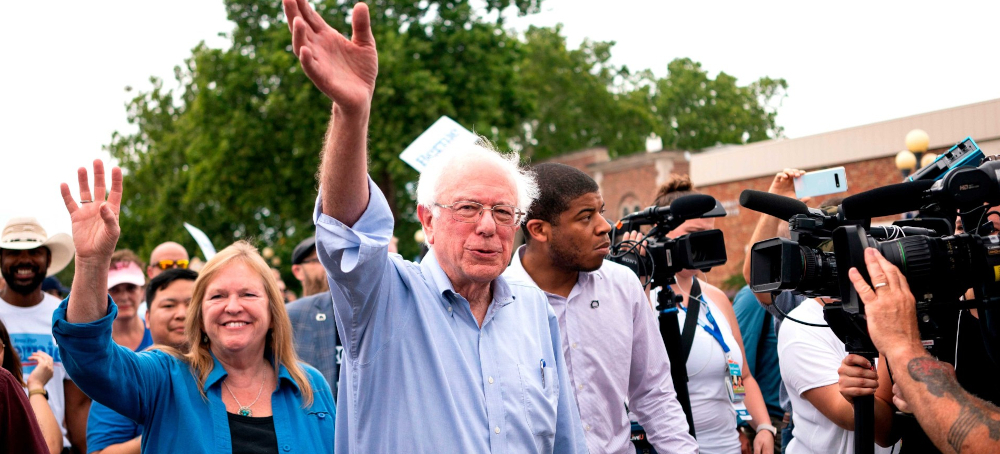 Then Democratic 2020 presidential candidate Senator Bernie Sanders (I-VT) waves as he walks with supporters and reporters at the Iowa State Fair in Des Moines, Iowa on August 11, 2019. (photo: Alex Edelman/Getty)
Democrats’ Long 2016 Primary Is Finally Over — And Sanders Won
David Weigel SemaforThe Democratic National Committee’s mandate that candidates reject super PACs or forfeit the 2028 debate stage surprised some likely candidates for the nomination. It didn’t surprise the Vermont independent senator, who had been asking as much for years from a party that he never joined.
“I believe the Party should make a public statement about our values and simultaneously consider actions that punish candidates who refuse to adhere to this principle,” Sanders wrote in a letter to then-DNC Chair Jaime Harrison in 2022.
Sanders did not have a close relationship with Harrison, who was picked to lead the party by Joe Biden. He has a friendly relationship with current DNC Chair Ken Martin — who, in a twist few Democrats might have called this summer, faces fewer post-midterm challenges for his job than Hakeem Jeffries or Chuck Schumer.
Now Martin has signed off on an idea that many Democrats considered well-meaning but unenforceable. The party can’t prevent super PACs or “dark money” groups (not always the same thing) from spending on behalf of candidates.
Its new Fair Campaign Practices Pledge asks candidates to tell the DNC if an outside group is spending in the primary and allows the DNC to punish those who don’t denounce that spending.
This hasn’t been universally welcomed by Democrats, who would rather be talking about Nvidia CEO Jensen Huang right now. But the story of Democratic politics since Sanders lost the 2016 primary to Hillary Clinton has been, eventually, the party giving Sanders what he wants. If Donald Trump led the most successful raid of a major party in modern history, Sanders is the unquestioned runner-up.
He’s succeeded for two basic reasons. One: Everything he’s asked for is both populist and popular. Two: Democrats would rather keep Sanders inside the tent than risk him rallying anti-establishment voters from outside.
He gets to put up stumbling blocks for the sort of party lifers, donors, and strategists who don’t want the left to win a Democratic nomination. They get party rules and priorities that prevent the left wing’s potential standard-bearer in 2028 (be it Ocasio-Cortez, Khanna, or another) from making sharp contrasts with a candidate more appealing to insiders.
It wasn’t inevitable, but Democrats were definitely heading in this direction. The mollification of Sanders started right before the 2016 party convention, when he declined to release his delegates before they could influence the party platform. While Clinton’s allies had more seats on key committees, they agreed to create a Unity Reform Commission to change party rules after the election — which, at that point, they assumed Clinton would win.
She didn’t, and the commission actually went to work, changing the primary process largely in line with what Sanders wanted. Had the change occurred in 2008, Clinton would have likely defeated Barack Obama; in 2016, Clinton would have padded her delegate count over Sanders.
I don’t think that Sanders out-smarted himself, but the rules-making Democrats definitely saw a win-win in opening primaries to more “normie” voters.
This week’s Fair Campaign Practices Pledge is more beneficial to the Sanders wing. It only commits candidates to shaming and shunning super PACs in the primaries; it’s understood that Democratic super PACs will wind up again for a 2028 general election.
“It creates a free rider problem where socialists can decry mainstream Dems for outside spending but still get the benefit of it if they ever win,” said Democratic strategist Caitlin Legacki, who opposes the change, and worked for Rep. Haley Stevens in the party’s Michigan Senate primary.
For the next year, a wet blanket will be thrown on Democrats who could get support from super PACs. If any governor wanted to follow Ron DeSantis, and divert his state election funds into a federal PAC — well, GOP commissioners on the FEC might let him, but the party wouldn’t. Some Democrats believe that the super PAC shaming policy will be toothless, but the Sanders wing clearly sees it as a win.
“A lot of progress [is] being made on getting dark money out of the Democratic primaries,” said Sen. Jeff Merkley, D-Ore., the only senator who endorsed Sanders over Clinton in 2016, on a Monday call organized to support Sanders-endorsed Senate majority leader candidate Chris Van Hollen. “Thank you, everybody who’s working on that!”
Sanders and his wing won this, again, without ever winning a presidential primary. The credit he’s gotten for changing the Democratic Party’s rhetoric and priorities this cycle has rankled some Democrats.
But this is the best of all possible post-2016 worlds for them. Sanders rebuffed supporters who wanted him to lead a third party, which would have split the anti-Trump opposition. He demanded that the party neuter “superdelegates” and then super PACs, which most Democrats basically agreed were big perception problems for their party.
Progressives are betting that these changes will help Democrats characterize Republicans as corrupt, at a moment when voters believe it. In 2016, Trump initially benefited from the fact that large GOP donors were horrified by him, and that he didn’t have a super PAC at all.
Who was defined as the candidate of big money and closed-door fundraisers? When the 2016 primaries were over, clearly, Hillary Clinton was — even though Trump will leave office as the most successful super PAC fundraiser of all time.
He’s piled up seven- and eight-figure donations, often from donors with business before his administration. Trump pulled Elon Musk into frontline politics, where the CEO became the biggest single super PAC donor in the country.
Democrats picked this moment to heighten the contrasts, ostentatiously opposing super PACs, bidding for the roving anti-establishment vote that seems to like this sort of thing.
The 2016 primary is over, and the 2028 primary can begin.