
Crops 'Stored Everywhere': Ukraine's Harvest Piles Up
Liz Alderman The New York Times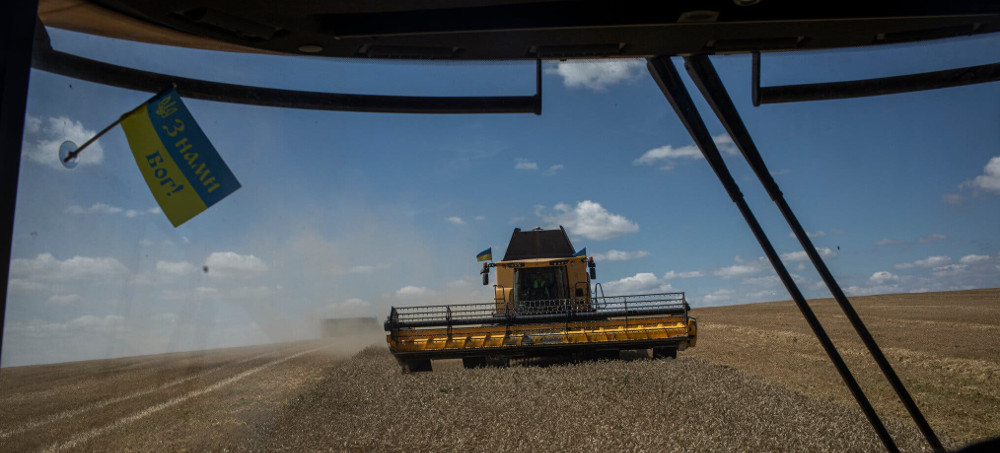 Workers harvested wheat to be processed at the Continental Farmers Group facility in Ukraine. (photo: Diego Ibarra Sanchez/New York Times)
Crops 'Stored Everywhere': Ukraine's Harvest Piles Up
Liz Alderman The New York TimesUnder a successful deal struck last week by the United Nations and Turkey, Moscow halted grain shipments to Ukraine through the Black Sea. If all goes according to plan, a ship laden with grain will sail from a Ukrainian port in the coming days, releasing crops from a major breadbasket to a starving world.
But despite the fanfare in Brussels and Washington, the agreement is being welcomed cautiously in the regions of Ukraine. Farmers who have been living for months at risk of Russian missile attacks and economic uncertainty are skeptical that there will be a deal.
The roar of the combine on these farms is a familiar racket this time of year, but most of the harvest will go straight into storage. Even after last week’s settlement, farmers believe the odds remain against them.
“The opening of Black Sea ports is not in itself the magic answer,” said Georg von Nolken, chief executive officer of Continental Farmers Group, a large agricultural business with vast areas around western Ukraine. “It is certainly a step forward, but we cannot assume that the deal will bring Ukraine back to where it was before the war,” he said.
The blockage has ignited wild price swings for crops and the cost of transporting them. Storage for the latest crop is running out, leaving many scrambling for temporary solutions.
A missile attack on Ukraine’s biggest Black Sea port of Odessa on Saturday shook confidence in the deal and risks undermining efforts before the deal is put into effect.
“No one believes Russia will attack again,” said Vasil Levko, director of grain storage at MHP, one of Ukraine’s largest agricultural produce companies.
There is political will from Ukraine’s allies: the White House welcomed the agreement, as did the United Nations and international aid organizations, which warned of possible famine and political unrest, Ukraine’s grain remains blocked for a long time.
Freeing up grain for shipment is expected to ease a growing hunger crisis caused by Russia’s aggression – not so much because Ukrainian grain can be shipped faster to desperate countries, but because more supplies can help drive down prices. which rose after the war but has been falling recently. “It’s quite positive,” said Nikolay Gorbakov, head of the Ukrainian Grain Union. “It is possible to find a way.”
Yet when reopened, Black Sea ports are expected to operate at about half their pre-war capacity, with experts saying the backlog of more than 20 million tonnes will cover only a portion of the grain. does. The ships would proceed through a path cleared of Ukrainian mines used to prevent Russian ships from entering, and would face inspections in Turkey to ensure that they did not take weapons back to Ukraine.
Our coverage of the Russo-Ukraine War
And it is uncertain whether enough ships will venture back. Shipping companies that once operated in the Black Sea have operated on other cargo routes. Insurers are wary of covering ships in a conflict zone, and without insurance, no one will ship.
Meanwhile, farmers in Ukraine are grappling with huge amounts of trapped grain from last year’s crop. Before the war, new crops moved in and out of grain elevators – from harvest to export – like clockwork. But Russia’s Black Sea barrier created a massive pile-up.
An additional estimated 40 million tonnes – wheat, rapeseed, barley, soy, corn and sunflower seeds – are expected to be produced in the coming months. Storage facilities not destroyed by Russian shelling are filling up, and space for freshly harvested crops is running out.
At an MHP grain processing center an hour east of Lviv, a truckload of freshly harvested rapeseed—small, shiny and black—has dumped its load into a sifter on a recent day. The seed was taken to a dryer and then funneled into a huge silo that still had some space available. A nearby silo didn’t: it was full of soybeans stuck there from a previous harvest.
A major concern was what to do with the wheat crop sown in the current winter, said Mr Levko, whose company uses the grain to make fodder for chicken farms in Ukraine, as well as grain for export. With its silos near capacity at the Lviv site, the wheat will be stuffed into tall plastic sheaths for temporary storage.
The company was scrambling to buy more sheaths, he said, but Russian rockets destroyed the only Ukrainian factory that makes them, and European manufacturers are swamped with orders and can’t keep up, Mr. Levko said. Told.
Updates
July 28, 2022, 12:15 am ET
After wheat comes the corn crop. Mr. Levko said it would have to be piled on the ground and covered with tarpaulin to protect it from the thousands of crows and pigeons hovering nearby like dark clouds, as well as the autumn rain, which can cause rot, Mr. Levko said. he said.
“The crops have to be gathered everywhere,” he said, spreading his hand across a vast field. He said that even if the deal to unblock the Black Sea has worked, it could take months before Odessa’s shipping capacity to help reduce the grain pile-up.
Meanwhile, farmers are trying to expand an alternative labyrinth of transportation routes that have been built across Europe since the outbreak of the war.
Before the Russian blockade, Ukraine exported seven million tons of grain a month, mostly on ships that could carry large loads. Since then, Ukraine has only been able to pump out around two million tonnes per month through a hastily cobbled patchwork of land and river routes.
The Continental Farmers Group used to export the crop through the Black Sea, Mr von Nolken said. Delivery by ship can arrive in the Middle East and North Africa in as little as six days.
But the blockade forced the company to put some of its grain on a curvy path, which included a vast circumnavigation around Europe on trucks, trains, ships and ships through Poland, the North Sea and the English Channel through the Strait of Gibraltar. Involves making a counterclockwise circle. Back in the Mediterranean, an odyssey that could take up to 18 days.
With so many exporters vying to get grain out of Ukraine, the cost of its transportation has soared from about $35 to $130 to $230 a ton before the war, with the eastern regions near Russian-occupied regions facing the sharpest price increases. It has to be done, Mr. von Nolken added. At the same time, grain prices within Ukraine have fallen by about two-thirds because the blockade prevented farmers from holding too much grain, threatening the livelihoods of many.
European countries are working furiously to solve one of the biggest challenges: the transport of grain by rail. Previously, Ukraine’s 38,000 grain cars mostly carried crops to Black Sea ports, but they run on Soviet-era tracks that Europe doesn’t match. Therefore rail shipments going elsewhere must now be transferred to other trains once they reach the border.
The biggest opportunity to increase exports lies with trucks. Roman Sleston, head of Ukraine’s main agricultural lobby, said his group was aiming to truck 40,000 tonnes of grain per day. By June, trucks were moving 10,000 tonnes per day.
But it still only relieves a portion of Ukraine’s backlog. And with so much traffic on the road, border crossings tend to get jammed. MFP’s Mr Levko said it now takes four days for grain trucks to travel from Ukraine to Poland – instead of four hours before the war. It takes 10 days instead of two to cross the Serbian border. The EU is trying to make backup easier with fast-track border permits.
“The question is, how long will the situation continue?” Mr von Nolken said. “On February 24, everyone assumed that it would be a one-week exercise. After more than 150 days, we are talking about reopening the port with reservations.
But a bitter truth still faces Ukraine. Despite the war, it has had a heavy harvest so far this year.
“We are creating a tsunami of grain, we are producing more than we can export,” said Mr. von Nolken. “We’ll still be sitting on crops that won’t come out.”