Community Leaders in Florida Say Trump’s FEMA Pullback Leaves Them Struggling to Fill the Void
Amy Green, Charles Paullin Inside Climate News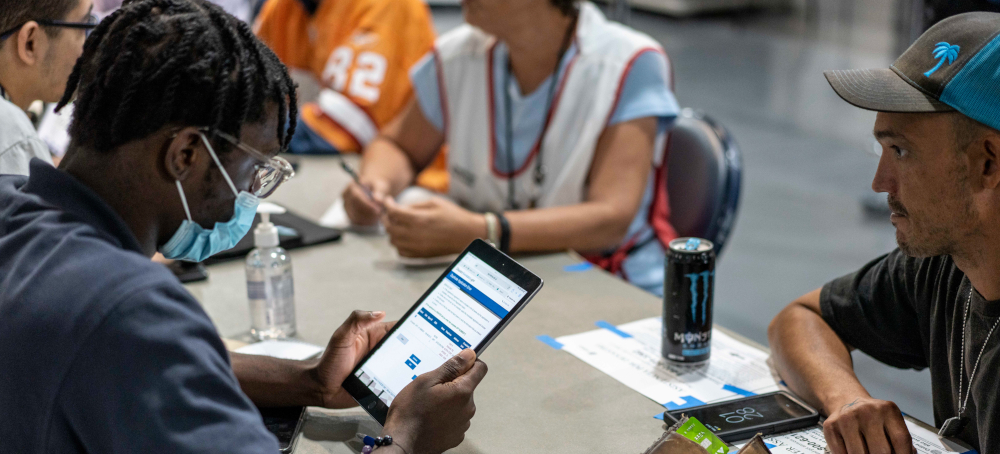 FEMA representatives take information from people displaced by Hurricane Ian at a shelter in Estero, Fla., on Oct. 3, 2022. (photo: Thomas Simonetti/Getty)
The president may have backed off killing the agency outright, but his FEMA Review Council clearly sees a much reduced emergency management role for the federal government.
“Those are the people that are reliant on FEMA to come in and help,” said Alan Harris, emergency manager in suburban Seminole County, Florida, outside of Orlando. “If they’re not coming in to help us at the local level, we’ll help to the best of our ability, but with no funding I don’t know what that is going to look like.”
That is the kind of concern circulating now among state and local emergency managers and others engaged in the work of disaster response, as the Trump administration aims to streamline the Federal Emergency Management Agency and hand over more of the agency’s responsibilities to state, local and tribal entities.
During his first week in office, President Donald Trump appointed a task force to evaluate FEMA and identify reforms. Not long after, he issued an executive order calling on state and local governments and individuals to “play a more active and significant role in national resilience and preparedness.” He even has suggested the possibility of eliminating the agency altogether.
When a panel Trump created called the FEMA Review Council released its long-awaited report earlier this month, its list of recommendations did not include dismantling the agency. But the council of experts did characterize the federal agency as at an inflection point and in need of major change because of “mission creep” under the Biden administration and also “endemic program failures.”
“It is time to close the chapter on FEMA,” the report stated. “A transformed agency should be established that retains the core missions of FEMA, while highlighting the renewed emphasis on locally executed, state or tribally managed, and federally supported emergency management.”
The council, in its report, described state and local governments as the frontline in recovery efforts after an emergency. The council said federal assistance should be reserved for “truly significant events” and acknowledged that when such events do occur, state and local governments would have to access federal assistance through a single entity, for efficiency.
The FEMA Review Council also recommended streamlining assistance programs and reforming the National Flood Insurance Program, which is administered by FEMA and burdened with more than $20 billion in debt, according to the report. The report said the program is based on outdated information, leading to a disconnect in the public’s perception of risk. The council said the changes should be phased in over two to three years and acknowledged legislative, policy and regulatory actions would be required for the recommendations to be implemented.
Localities and states have long led disaster response on the ground, Casey Tingle, a senior vice president at Plexos Group, an infrastructure consultancy, said during a webinar with the Southern Environmental Law Center. Any reductions in federal funding for recovery funds, said Tingle, former director of the Louisiana Governor’s Office of Homeland Security and Emergency Preparedness, “we just need to have a very honest and transparent discussion about that one by one.”
Proposals to shift funding from the federal government to states and localities can be beneficial, Tingle said, “but when you layer them together and combine them, that can dramatically shift the financial responsibility for these events.”
The role of FEMA extends to funding hazard mitigation on the front end, like improving aging stormwater drainage systems. Leaving localities to fund those projects could interfere with other priorities, said Casi Callaway, principal at Activate-Build-Connect, Inc. a resiliency advisory group, and former chief resilience officer of the City of Mobile, Alabama.
Despite knowing the benefits of reducing flooding by upgrading a stormwater pipe, Callaway said, “it’s really hard for a city councilor or even citizens to say, ‘yes, please do that instead of the park, which is pretty, which is where my kids play,’” she said.
Without funding ways to reduce storm damage upfront, businesses, homes and economic priorities could be damaged, she said.
“The economy and our natural resources, disasters are intrinsically linked,” said Callaway. “If we are not investing before the disaster comes, our economies are going to suffer. Certainly, our community and people suffer as well.”
It’s no question that the frequency, severity and cost of disasters are going up, according to an analysis by the Pew Charitable Trusts. In the 1980s, there were just under 40 total storms that caused over a billion dollars in damage, adjusted for inflation. In the 2010s, that number grew to over 120. This decade there’s been just under 120 billion-dollar storms through 2024, with six more years to go.
“Disasters are getting more extreme, severe, expensive, frequent, however you want to phrase it,” said Peter Muller, senior officer of managing fiscal risks at the Pew Charitable Trusts.
Post-pandemic revenue growth helped state reserves become pretty flush in 2024, Muller said, but they are now becoming constrained dealing with rising costs. Muller said he researched the highest level of disaster aid the federal government doled out to each state over the last 20 years. For eight states, that figure equaled more than 50 percent of their reserve levels for 2024. For a couple states, like Louisiana and Mississippi when hit by Hurricane Katrina, the aid equaled more than 100 percent of their 2024 reserve level.
“When those big events hit, states are extremely reliant on the federal government to come in and help provide support,” Muller said. “That’s not something that can be easily replaced with state dollars.”
Some of the recommendations in the report do not differ all that much from what already is in place, said Joanne Pérodin, vice president of programs at the CLEO Institute, a Florida-based nonprofit dedicated to climate education and advocacy. She also pointed out that state and local governments already are leaders in any recovery after a disaster.
But she wished for more clarity on when the federal government would get involved. She also wished the council could have acknowledged that different states and regions face varying risks, from hurricanes in the Southeast to wildfires in the West. States also have a range of tax structures, putting them in different financial situations when an emergency occurs. She feared the gap left by FEMA would most affect disadvantaged communities with the least resources for dealing with disasters.
“How are those states going to manage filling that major gap?” asked Pérodin, who served on the White House Environmental Justice Advisory Council during the Biden administration. “If the conversation is around resilience building—making those regions stronger and better-prepared for dealing with disasters—what kind of training will be provided? What kind of resources will be available?”
Harris, the emergency manager in Florida, cheered the efforts to streamline FEMA. But he shared Pérodin’s concern about state tax structures. With no personal income tax in Florida, local governments here get the bulk of their funding through property and sales taxes. At a time when state leaders are considering rolling back property taxes, to help defray sky-rocketing insurance costs and make housing more affordable, he worried about local funding for a disaster.
“Saying that the federal government will do less and the state and local governments need to do more, there has to be some funding mechanism for that,” he said. “Disasters aren’t slowing down. They seem to be speeding up, so we have to be prepared for that.”