
Climate Gates, Maybe We Don't Need Billionaire Opinions on Everything
Bill McKibben Bill McKibben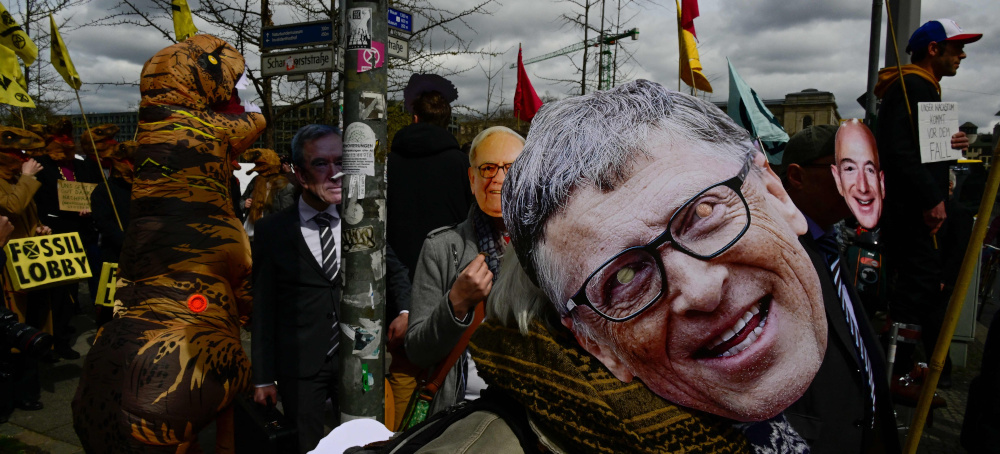 2023 Berlin demonstration from Extinction Rebellion against really rich and irresponsible guys. (photo: Getty)
 Climate Gates, Maybe We Don't Need Billionaire Opinions on Everything
Bill McKibben Bill McKibbenALSO SEE: Bill McKibben | The Crucial Years (Substack)
Maybe we don't need billionaire opinions on everything
The truth is that we have failed to avoid an overshooting above 1.5C in the next few years. And that going above 1.5C has devastating consequences. Some of these devastating consequences are tipping points, be it in the Amazon, be it in Greenland, or western Antarctica or the coral reefs.’In fact, I could probably just note that Gates, with impeccable timing, decided to drop his remarks at the same moment that Hurricane Melissa plowed into Jamaica, doing incalculable damage because of winds made stronger by the ocean heat attributable to global warming. As Jeff Masters reported
Human-caused climate change increased Hurricane Melissa’s wind speeds by 7% (11 mph, or 18 km/h), leading to a 12% increase in its damages, found researchers at the Imperial College of London in a rapid attribution study just released. A separate study by scientists at Climate Central found that climate change increased Melissa’s winds by 10%, and the near-record-warm ocean waters that Melissa traversed — 1.2 degrees Celsius (1.2°F) warmer than average — were up to 900 times more likely to be that warm because of human-caused climate change.And, oh, the same day Hue, in Vietnam, reported one of the two or three greatest rainfalls in recorded human history: : five feet of rain in 24 hours, the kind of deluge made ever more likely by a warming atmosphere that can hold more water vapor. As the Associated Press reported, “global warming is making tropical storms stronger and wetter, according to experts, because warmer oceans provide them with more fuel, driving more intense winds, heavier rainfall and shifting precipitation patterns across East Asia.”
Anyway, Bill Gates’ letter.
It was wrong of him to write it because if his high-priced pr team didn’t anticipate the reaction, they should be fired. I assume they did, and that they were okay with the entirely predictable result from our president. Here’s how the Washington Times described it:
“I (WE!) just won the War on the Climate Change Hoax,” said Mr. Trump in a Wednesday post on Truth Social. Bill Gates has finally admitted that he was completely WRONG on the issue. It took courage to do so, and for that we are all grateful. MAGA!!!”Bill Gates didn’t, of course, say that. He said climate change was real and we should be worried about it, but that it wouldn’t lead to “humanity’s demise” or “the end of civilization” (which seems like the lowest of low bars) and that
Although climate change will hurt poor people more than anyone else, for the vast majority of them it will not be the only or even the biggest threat to their lives and welfare. The biggest problems are poverty and diseaseand therefore that’s where we should focus our money. His letter is actually directed at delegates to the global climate conference next month in Brazil, essentially telling them to back off the emissions reductions and concentrate on growing economies in the developing world because “health and prosperity are the best defense against climate change.”
Any conversation about Bill Gates and climate should begin by acknowledging that he’s been wrong about it over and over again. He’s explained that up until 2006—i.e., 18 years after Jim Hansen’s testimony before Congress laying out the science, and well past the point where George W. Bush had acknowledged its reality—he like Trump thought the whole thing was a crock. “I had assumed there were cyclical variations or other factors that would naturally prevent a true climate disaster,” he explained—at the time he was the richest man in the world, and yet his scientific advisors couldn’t get across the simple facts to him.
And he was last heard from on the topic in 2021, when he wrote a book explaining that it was going to be very hard to do renewable energy because it came with a “green premium”—i.e. it cost more. Sadly for his argument, that was pretty much the year that sun and wind crossed the invisible line making them less expensive than coal and oil and gas. (You can read my review from the New York Times here, and you can read his response to it in Rolling Stone here where he explains “McKibben is stuck in this time warp.”)
So—if we were listening to people on the grounds of whether they had a good track record, the world would not spend a lot of time on Gates and climate. But if you have a hundred billion dollars all is forgiven, and so there has been lots of fawning coverage. The fact that Gates framed all this in a way designed to appeal to the president is so obvious that it hardly bears mentioning (the richest men in the world have all been sucking up to him, so no extra shame here); let’s instead just go to the heart of his argument. Which is weak in the extreme.
Take the case of Jamaica. The warming-fueled hurricane that smashed into the island on Tuesday did a lot of damage. How much? The first estimates from the insurance industry say between 30 and 250 percent of the country’s annual GDP. The wide range is because we don’t yet have pictures from much of the country, so let’s go with the very low end of the range. Thirty percent of a country’s GDP is…a lot of money. It’s as if Hurricane Katrina had cost America $8 trillion. If America suddenly had an $8 trillion hole, what do you think that would do to its ability to pay for education and health care and the like? That’s what “development” is. Jamaica is in a hole it will spend forever getting out of.
And oh, Cuba and Haiti got smacked too. And Vietnam. And…and that was just last week. According to the National Bureau of Economic Research, every one degree climb in temperature knocks 12 percent off GDP. The paper concluded that “by the end of the century people may well be 50% poorer than they would’ve been if it wasn’t for climate change.” And who gets hurt the most? That would be the developing countries that Gates in theory worries about. Here’s a Stanford study showing that “The gap between the economic output of the world’s richest and poorest countries is 25 percent larger today than it would have been without global warming.”
Gates goes on and on about public health, but as the U.S. Global Leadership Coalition (a group he has lauded extensively) said a few years ago,
Warmer temperatures could expose as many as one billion people to deadly infectious diseases such as Zika, dengue, and chikungunya. In the U.S. alone, disease cases from mosquitoes, ticks, and fleas more than tripled from just under 30,000 to almost 100,000 a year from 2004 to 2016. A warmer climate could lead to an additional 250,000 people dying of diseases including malaria each year between 2030 and 2050, according to the World Health Organization.Is this a smaller effect than the things he worries about? On the same day that Gates issued his letter, the premier medical journal the Lancet issued its annual update on climate and health, and what it found was
Rising global heat is now killing one person a minute around the world, a major report on the health impact of the climate crisis has revealed.It says the world’s addiction to fossil fuels also causes toxic air pollution, wildfires and the spread of diseases such as dengue fever, and millions each year are dying owing to the failure to tackle global heating.
The irony of Gates’ new letter is that he acknowledges, in passing, how wrong he was four years ago about the “green premium.”
You probably know about improvements like better electric vehicles, dramatically cheaper solar and wind power, and batteries to store electricity from renewables. What you may not be aware of is the large impact these advances are having on emissions.Ten years ago, the International Energy Agency predicted that by 2040, the world would be emitting 50 billion tons of carbon dioxide every year. Now, just a decade later, the IEA’s forecast has dropped to 30 billion, and it’s projecting that 2050 emissions will be even lower.
But he uses that new knowledge to argue that since they’ve done so well we’ve knocked the high end off climate projections and hence can calm down about it all. He misses the most obvious point, which is that if you care about development the rapid expansion of solar and wind power give us the greatest possible chance we’ve ever had to really knock down poverty, at exactly the same point that we’re spreading the technology that can help limit how high the temperature eventually gets.
Jigar Shah, who led the Department of Energy loans office under Biden, put it best:
Bill Gates hasn’t made sense on Climate since he teamed up with Bjorn Lomborg in 2009. This is just a restating of Bjorn’s book from this year about how we have a finite amount of money and we shouldn’t use it for climate. What they get wrong is that climate solutions are now fully profitable.Here’s Rajiv Shah, writing in the New York Times last year, about the opportunity
As world leaders gather this week for the United Nations General Assembly they should reimagine their approach. In today’s digital world, nothing matters more to individual well-being than energy: Access to electricity determines fundamental aspects of individuals’ lives, like whether they are healthy or have a job.Instead of treating electrification as one of many goals, it’s time to see it is essential to all of them. And that means the world needs to focus investment and effort on getting reliable, clean electricity to the nearly 700 million people who don’t have any — and the 3.1 billion more who don’t have enough.
As Rajiv Shah explained in the headline to that article, “Want to End Poverty? Focus on One Thing.” Clean electricity.
I doubt Rajiv Shah can say anything about Gates’ letter—he worked at the Gates Foundation for years as part of his long and distinguished career. In fact, not many people can really reply—Gates money is too important to too many agencies and organizations. But since I don’t get any of it, let me say: he’s really not the guy to be listening to on this stuff. Really.
In other energy and climate news:
+Illinois governor J.B. Pritzker is building up a pretty powerful portfolio of clean energy measures—in some ways, more impressive than Gavin Newsom in California who has been backtracking hard on residential solar. This week Pritzker is expected to sign an important bill allowing rapid deployment of virtual power plants in the Land of Lincoln. As Jeffrey Tomich reports
A centerpiece of the omnibus energy bill orders the Illinois Power Agency (IPA), which buys power for the state’s investor-owned utilities, to procure 3 gigawatts of battery storage by 2030. The original bill required 6 gigawatts, but Democrats lowered the target to get the measure passed before the fall session ended Thursday night.The battery requirement aims to complement the state’s growing renewable energy fleet, as well as counter rising prices for power plant capacity from PJM Interconnection and the Midcontinent Independent System Operator (MISO) — two large regional power grids that run through the state.
The Illinois Power Agency estimates that adding 3 GW of battery storage would carry a net cost of more than $1 billion between 2030 and 2050, when including financing. The power agency’s analysis also found that the move would also benefit Illinois consumers by suppressing capacity prices in PJM and MISO.
+Fascinating news from Michelle Wu’s Boston, where the world’s biggest heat pump will soon be powering large percentages of the city’s homes and businesses. Martha Muir reports:
Unlike European water-based systems, most US energy networks use steam, and cities such as Boston have “steam lines” running across them that deliver heat to buildings. Everllence’s technology, which combines vapour and steam compression, creating high-pressure steam at up to 50 bar and more than 300 degrees, provides decarbonised steam through the same network — a “tremendous cost saver to the city”.+Jessica Corbett reports on the growing call from climate campaigners for a tax on the superwealthy to pay for changes we need
Noting Tesla’s annual general meeting on November 6, Greenpeace called on governments “to lay the ground for a global tax reform” negotiations for a UN Framework Convention on International Tax Cooperation, scheduled to start in Nairobi, Kenya on November 10—the same day the climate summit, COP30, is set to begin in Belém, Brazil.“Instead of enabling one person to become a trillionaire, governments should unlock that same scale of wealth—the $1.7 trillion, which a billionaire and multimillionaire tax could generate per year globally—to protect lives and secure our common future,” said Fred Njehu, Greenpeace Africa political lead for the Fair Share campaign, in a statement.
“A fair billionaire tax could fund climate flood prevention, clean air, green cities, affordable housing, and nature protection,” Njehu noted. “There is no lack of money, only a failure to make the richest of the rich pay their fair share. Governments must act on behalf of the majority of people and listen to what many economic experts suggest: Tax the superrich and their polluting corporations to finance a fair green transition.”
+Great new report from the team at the European think tank Ember on how the rise of cheap battery storage is changing the way we think about energy—more like the way we think about agriculture
There is a clear parallel with the agricultural revolution here. When early societies learned to farm, they began producing food in place — harvesting from the same fields again and again instead of chasing animals across vast territories. That shift unlocked far greater energy yields from the land, rising by roughly two orders of magnitude in most estimates. The result was abundance, settlement, and growth: the foundation of civilisation itself.An analogous revolution is now underway in energy. By shifting from tracking down and collecting fossil fuels to farming sunshine, wind, water and heat from the ground, we are unlocking a resource base that is more local, steady and vastly larger: capable of supplying orders of magnitude more energy than fossil fuels — with every nation sitting atop renewable resources at least ten times, and for some a thousand times, greater than its demand. As renewable generation scales and electrification carries it through the economy, the age of electrotech marks a new period of energy abundance.
Along the same lines, are you curious about how automakers are advertising EVs? Here’s how Ford is encouraging people to buy a F-150 Lightning pickup, under the headline “your truck could be your new side-hustle.”
Now, with Ford Home Power Management, in select markets where electricity rates change throughout the day, customers that purchase the Ford Charging Station Pro, Home Integration System, and Home Power Management software can charge their F-150 Lightning with lower cost electricity — often overnight during off-peak hours — and then use that stored energy to power their home at a later time when grid electricity rates are higher during peak hours.And the savings are real. Some customers can save up to an estimated $42 per month or around $500 per year by using Ford’s Home Power Management software with the available Home Integration System.2
But the savings could be even more depending on your local utility program. For example, with TXU Energy in Texas, Ford F-150 Lightning pickup drivers could potentially save an average of $900 per year with TXU Free EV Miles.3
And, of course, any time a customer needs their vehicle or wants to drive somewhere, they can simply unplug or use the Ford Energy app to stop the flow of power from their F-150 Lightning to the home. Customers are always in control of their electric vehicle’s battery energy.
+Heavy rains in New York yesterday—enough to kill two dwellers, who drowned in their flooded basement apartments. This sadly is not new—14 New Yorkers died as the remains of Hurricane Ida swept across the area in 2014. Just noting that Zorhan Mamdani, though not especially vocal about climate during his campaign, has done a good job of tying it to his affordability agenda
+Emily Atkin has her usual excellent and indignant report, this time about the defenestration of the excellent climate news team at CBS under its new ideologically driven leadership. She quotesMark Hertsgaard of Covering Climate Now:
“Our founders believed that democracy could not survive unless the public was fully informed and could make informed choices as citizens,” he said. “There is no bigger issue facing the world or America right now than climate change. It’s a five alarm fire, and we should be treating it like that, not retreating from the story.”+On Bluesky, which has emerged as the main place for climate researchers to trade news, University of Utrecht researcher Swinda Falkena walks readers through a new paper offering more indications that we may be seeing the early moments of the breakdown of the great Atlantic currents
+This seems cool: A Texas company is pioneering new “three-dimensional” solar panels that generate 50% more energy than flat panel systems. Since, in fact, all solar systems are “three-dimensional,” a picture may help here
As Mrigakshi Dixit reports:
The technology solves key challenges faced by conventional solar farms: limited land availability and low energy output per square foot.The vertical solar towers are developed to deliver 50% more energy.
Interestingly, the tech achieves this performance while utilizing only one-third of the land area required by standard arrays.
Plus, the tower’s patented design maximizes space, achieving three times the solar surface area exposure within the same amount of land.
A core innovation of the system is its generation profile. The vertical stacking of the panels allows the towers to capture low-angle light throughout the day.