
Clarence Thomas Against Progressivism—and Progressives
Ruth Marcus The New Yorker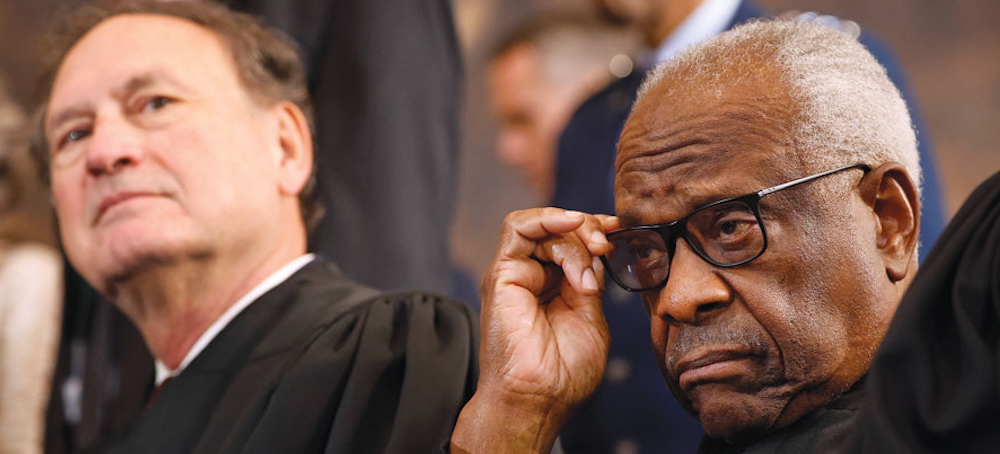 Supreme Court Justices Samuel Alito, left, and Clarence Thomas. (photo: Chip Somodevilla/AP)
 Clarence Thomas Against Progressivism—and Progressives
Ruth Marcus The New YorkerDuring his confirmation hearings, in 1991, Justice Clarence Thomas employed an arresting image to assure senators that he would be an impartial jurist. Taking the bench means “having to strip down, like a runner, to eliminate agendas, to eliminate ideologies,” Thomas said. “It is an amazing process, because that is precisely what you start doing. You start putting the speeches away, you start putting the policy statements away.” Earlier this month, the seventy-seven-year-old Thomas became the second-longest-serving Justice in history, surpassing John Paul Stevens, who retired after thirty-four years, in 2010. If Thomas remains on the bench until May 20, 2028—and he shows no signs of leaving—he will outlast the record set by William O. Douglas, who stepped down from the Court after thirty-six years, in 1975. But Thomas long ago left his runner analogy in the dust—and he has not exactly put away the speeches. A few weeks before eclipsing Stevens’s record, he delivered a revealing—and, to many who heard it, unsettling and ahistorical—lecture on what should have been an uncontroversial topic: the two-hundred-and-fiftieth anniversary of the Declaration of Independence.
Speaking at the University of Texas at Austin, at the invitation of its new School of Civic Leadership, part of a wave of conservative-inflected entities being created at public universities in Republican states, Thomas sounded themes that have been woven through his jurisprudence: that God bestowed the “certain unalienable rights” of the Declaration, and that government serves merely to implement them. Dissenting in the 2015 case Obergefell v. Hodges, which found a constitutional right to same-sex marriage, Thomas complained that the majority “rejects the idea—captured in our Declaration of Independence—that human dignity is innate and suggests instead that it comes from the Government.” In his Texas speech, Thomas expanded on that idea. “None of our rights come from the government,” he said. “It is the Declaration that announces the ends of government. The Constitution achieves this purpose by protecting our natural rights and our liberties from concentrated power and excessive democracy.”
Some of Thomas’s critique appeared to be aimed at weak-willed conservatives, including his fellow-Justices, for being, as Thomas perceives it, too spineless to stand up for the ideals enshrined in the Declaration. “They get so swept up in the euphoria of acclamation and acceptance that they put aside their convictions. They water down their message, negotiate against themselves, vote against their principles, and hide in the tall grass,” Thomas said. “They recast themselves as institutionalists, pragmatists, or thoughtful moderates, all as a way of justifying their failures to themselves, their consciences, and their country.” He continued, “It did not take me long, in Washington, to stop wondering why the Supreme Court took sixty years to overrule Plessy v. Ferguson, the 1896 decision that endorsed government-enforced racial segregation and validated the Jim Crow South that I grew up in.” The Justices must have known that “Plessy was a hideous wrong,” he said, but “they may have been afraid of losing their social standing. They may have been afraid of bad press.” To hear the bitterness in these words is to wonder, Will the end of this Supreme Court term reveal another instance of conservatives falling short of where Thomas believes they should go?
Thomas, in a shout-out that he surely knew would irritate his liberal critics, welcomed two of those in attendance at the lecture, “our dear friends Harlan and Kathy Crow.” (In 2023, ProPublica reported that Thomas had failed to disclose lavish vacations funded by Harlan Crow, and the sale of his mother’s home to Crow.) But the Justice reserved his most incendiary remarks for progressives and Progressivism, the early twentieth-century reform movement that sought to harness government to counter corporate power. In Thomas’s telling, “Progressivism seeks to replace the basic premises of the Declaration of Independence and hence our form of government. It holds that our rights and our dignities come not from God but from government.” Progressivism, he said, “was the first mainstream American political movement—with the possible exception of the pro-slavery reactionaries on the eve of the Civil War—to openly oppose the principles of the Declaration.”
Thomas singled out Woodrow Wilson—a political scientist, a Progressive, and a Southern Democrat, who, as President, from 1913 to 1921, segregated the civil service and helped create the modern bureaucratic state, including the Federal Reserve and the Federal Trade Commission. “To Wilson, the unalienable rights of the individual were, quote, a lot of nonsense,” Thomas said. “Wilson redefined liberty not as a natural right attendant and antecedent to the government but as, quote, the right of those who are governed to adjust government to their own needs and interests.” Wilson, Thomas said, “described America still stuck with its original system of government as, quote, slow to see the superiority of the European system,” and saw the public as “selfish, ignorant, timid, stubborn, and foolish.”
Thomas went on to link Progressivism to the worst crimes of the twentieth century. “The European system that Wilson and the Progressives scolded Americans for not adopting, which he called nearly perfect, led to the governments that caused the most awful century that the world has ever seen. Stalin, Hitler, Mussolini, and Mao all were intertwined with the rise of Progressivism, and all were opposed to the natural rights on which our Declaration are based,” Thomas said. “Many Progressives expressed admiration for each of them shortly before their governments killed tens of millions of people.” He warned that the danger of Progressivism persists to this day: “Since Wilson’s Presidency, Progressivism has made many inroads into our system of government and our way of life. It has coexisted uneasily with the principles of the Declaration. Because it is opposed to those principles, it is not possible for the two to coexist forever.”
Thomas’s account of Progressivism as a malign force threatening individual liberty echoes an argument developed by scholars at the conservative Claremont Institute. When I asked Charles Kesler, a senior fellow at the institute and the editor of the Claremont Review of Books, about the significance of Thomas’s address, he invoked Abraham Lincoln’s in 1858, on the existential stakes for a nation riven by slavery. “This is really Thomas’s, in a strange way, his ‘house divided’ speech,” Kesler told me. “He doesn’t expect the Union to fall, but he doesn’t expect it to remain half slave and half free permanently. It will become all one or all the other.” Ronald Pestritto, also a senior fellow at Claremont and the graduate dean at Hillsdale College, wrote in praise of Thomas’s speech: “The Left doesn’t want us to notice that they predicate their core governing vision on a rejection of America’s founding principles, and so they are bound to protest Thomas’s account. Yet his account is dead-on accurate, and for proof one need only look to the original Progressives, who were open in their disdain of the Declaration of Independence and the Constitution. In this, they were far more honest than their present-day cousins.”
Numerous scholars of the Progressive Era with whom I spoke said Thomas had offered up a distorted version of the movement. Nancy Unger, a past president of the Society for Historians of the Gilded Age and Progressive Era and a professor emerita at Santa Clara University, said, “Progressives were not perfect, and I don’t pretend that they were, but this is such a misrepresentation of who they were. The driving force for most Progressives was not that they were anti-American, not that they were anti-Declaration of Independence and Constitution, but that they were saying, ‘Look, this is a different nation than when we started, we’re an industrial, urban nation, and a lot of things that didn’t require government before do so now.’ So to turn that into some kind of vilification, I just think, is unconscionable.” Christopher Nichols, a historian of the Progressive Era at the Ohio State University, said of Thomas’s account, “It’s a deeply problematic reduction of Progressivism to its most negative elements,” including racism and support for eugenics. Thomas’s speech, Nichols continued, “absolutely mistakes and conflates figures like Stalin and Hitler and Mussolini as Progressives, none of whom would have defined themselves as such, or were defined in their eras as such.”
As Matt Ford noted in The New Republic, Wilson offers a convenient target, given an ugly record of racism that led Princeton, in 2020, to remove his name from the public-policy school, as an “inappropriate namesake.” But Thomas’s focus on Wilson misrepresents his role in the Progressive movement. “Presenting Wilson as the inventor of progressivism is historically illiterate, akin to saying that Joseph Stalin invented communism or that Ronald Reagan invented conservatism,” Ford wrote. (Thomas never mentioned Wilson’s Progressive predecessor, Theodore Roosevelt, a Republican.) In addition, as John Milton Cooper, Jr., the author of a 2009 biography of Wilson, pointed out, Thomas overstated Wilson’s rejection of natural rights. “Think of this deeply, thoughtfully, intellectually religious man not believing in natural rights—come on, you can’t believe that,” Cooper told me. Wilson’s father was a Presbyterian minister, and Wilson read the Bible daily.
Thomas’s indictment of Wilson rests on a tendentious interpretation of his writings and speeches. Wilson did use the word “nonsense” in relation to unalienable rights, but nowhere near as dismissively as Thomas claims. “No doubt a great deal of nonsense has been talked about the inalienable rights of the individual, and a great deal that was mere vague sentiment and pleasing speculation has been put forward as fundamental principle,” Wilson wrote. But his point was not to diminish individual rights; it was to elevate their importance. “The individual,” he continues, “is indisputably the original, the first fact of liberty. Nations are made up of individuals, and the dealings of government with individuals are the ultimate and perfect test of its constitutional character. A man is not free through representative assemblies, he is free in his own action, in his own dealings with the persons and powers about him, or he is not free at all.”
Far from scorning the Declaration, Wilson praised it as a “great document,” undergirded by the “assertion that men have always the right to determine for themselves” whether their government is being run in a way “likely to effect their safety and happiness.” He cautioned against an emphasis on its soaring preamble—“the rhetorical introduction,” he said in a 1911 speech, “is the least part of it”— but only because he wanted to insist that modern-day Americans focus on the grievances of their own era. “How are we going to realize the conceptions of the author of the Declaration of Independence in our own day?” he asked.
Wilson pointed to nineteenth-century German architects of government reform, whose expertise in bureaucratic management he admired. But he advised that their system could not easily be transplanted to the United States. “We should not like to have had Prussia’s history for the sake of having Prussia’s administrative skill; and Prussia’s particular system of administration would quite suffocate us,” he wrote in an 1887 essay, “The Study of Administration.” “It is better to be untrained and free than servile and systematic.” Wilson did speak condescendingly of the public, but his larger point was that the people needed to be educated and convinced of the imperative for reform. “Wherever regard for public opinion is a first principle of government, practical reform must be slow and all reform must be full of compromises,” he wrote. “For wherever public opinion exists it must rule.”
Did Thomas take Wilson out of context? When I ticked through the various quotes with Kesler, he acknowledged that, at times, Thomas had perhaps offered a “loose formulation,” as in his assertion that Wilson viewed inalienable rights as “nonsense.” As to Thomas’s most striking accusation, linking Progressives to Hitler, Stalin, and Mao, Kesler said, “This is also a bit of a loose formulation,” adding that Thomas had “hooked together two things, which are not as intimately related as maybe he’s asserting here. . . . On the connection between the American progressive movement, even in its Wilsonian form, and fascism and communism, there’s no vital connection, I would say.”
Thomas’s speech was, Kesler noted, an “unusual Supreme Court Justice’s speech.” But it’s appropriate and common for Justices to make speeches, and the public benefits from hearing their views—even if some out-of-court comments have strayed too far into partisanship or vitriol. During the 2016 campaign, Justice Ruth Bader Ginsburg called Donald Trump a “faker” and said she couldn’t imagine “what the country would be” with him as President; Ginsburg quickly apologized for her “ill-advised” comments. Last month, Justice Sonia Sotomayor took an undisguised swipe at Justice Brett Kavanaugh, although not by name, for his breezy dismissal of the burden imposed by what he called “typically brief” questioning of citizens and people in the country legally by immigration officers. “This is from a man whose parents were professionals,” she said, and who “probably doesn’t really know any person who works by the hour.” Sotomayor also apologized for her “hurtful comments.”
Stephen Gillers, a legal-ethics expert and an emeritus professor of law at New York University, told me that, in his view, Thomas’s speech did not cross any ethical lines. “He could be wrong historically, and it doesn’t create a problem for him as a Justice under the new Supreme Court code,” Gillers said. (In 2023, the Court adopted its first code of conduct, which permits Justices to give speeches on the legal system, among other topics.) Others were more critical. “I thought this was the most inappropriate thing I’ve ever seen a Supreme Court Justice say,” Michael Klarman, a constitutional historian at Harvard Law School, told me. “Justices are not supposed to be or appear to be anything but impartial. And I can’t think of another example in American history where a Justice went and condemned the political views of tens of millions of Americans.” Erwin Chemerinsky, the dean of Berkeley Law, described the speech as “jarring.” Thomas, he said, has “taken what should be a unifying event for the country”—the two-hundred-and-fiftieth anniversary of the Declaration—“and tried to claim it for one side.”
Thomas has spent thirty-four years firmly anchored on the Court’s right flank. When the Court eliminated the constitutional right to abortion, in 2022, Thomas complained that it had not gone far enough, and should jettison other decisions that relied on similar reasoning—rulings that guaranteed access to contraception, struck down sodomy laws, and enshrined a right to same-sex marriage. In the Court’s ruling on the Voting Rights Act last month, Thomas not only concurred in the majority’s dismantling of a key section of the law that prohibits practices that have the effect of denying racial minorities the right to vote, he restated his iconoclastic view that the provision does not apply to districting. Last week, when the Court allowed continued access by mail to the abortion medication mifepristone, Thomas, who was one of only two dissenters (the other was Justice Samuel Alito), went so far as to assert that companies manufacturing the drug were engaged in a “criminal enterprise,” in violation of the Comstock Act, an 1873 law that prohibits mailing any “article or thing designed, adapted, or intended for producing abortion.” (The law was not at issue before the Justices.) More than any other Justice, Thomas is willing to overturn precedents when they collide with his originalist approach. But there is a difference between his expression of unflinching conservatism, on the bench and off, and his willingness, even his zeal, to condemn an entire political movement, one with more than historical interest. The first is jurisprudence, however extreme. The other veers into a political realm where judges, as Thomas once told us, have no business.