
Civilians Are Desperate for Food and Medicine Amid Houthi Advance in Yemen
Suzan Haidamous and Mohamad El Chamaa The Washington Post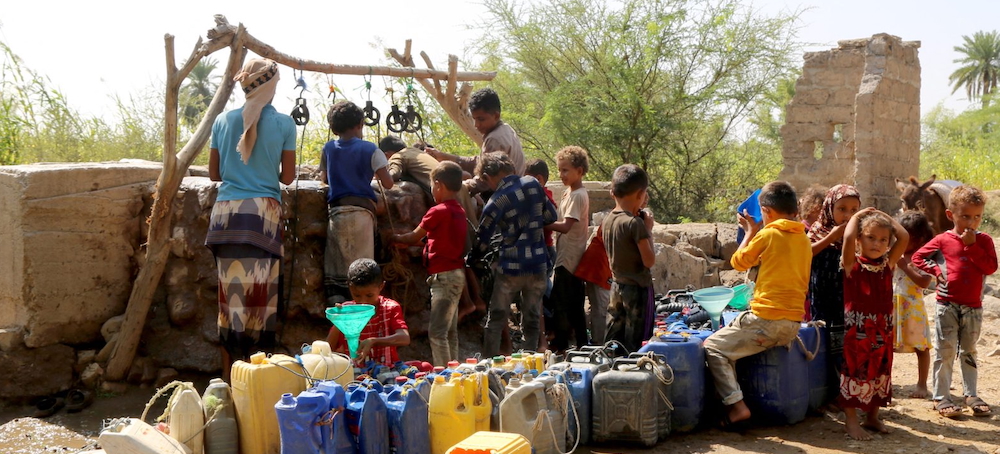 Displaced children in Yemen gather near a water well. (photo: Khaled Ziad/AFP/Getty Images)
Civilians Are Desperate for Food and Medicine Amid Houthi Advance in Yemen
Suzan Haidamous and Mohamad El Chamaa The Washington Post
Yemen is sinking into a humanitarian crisis as the Middle East braces for the prospect of renewed war, which President Donald Trump has threatened after the midterms.
The intensified fighting, both as a front in the conflict that has spread across the Middle East since the United States and Israel attacked Iran in February and as a continuation of a bitter civil war that has raged on and off for more than a decade, has displaced more than 300,000 people, according to the United Nations.
Since September, the Houthis have seized wide swaths of territory, giving them substantial control over the Bab al-Mandab strait, and launched far-reaching attacks on Saudi infrastructure.
Last month, the rebel group surrounded entirely the city of Taiz, restricting the flow of food, fuel and medicine to hundreds of thousands of people, in what Human Rights Watch says could amount to a “war crime.”
Ammar Alswaei, a resident of the city, said he has been desperate to see his daughter since the siege began. She had left for a surgical procedure before the city was encircled. “I find myself grappling with a dire situation, she is stranded and unable to return to Taiz because the roads are cut off,” he told The Washington Post in an interview by phone.
The renewed fighting has killed at least 68 civilians, half of them children, and injured at least 204, according to the U.N.
The Houthis are pursuing their own score against the Yemeni government and Saudi Arabia. But their advance also increases Iran’s leverage. President Donald Trump has threatened a return to wider-scale attacks after the U.S. midterm elections Tuesday. “At some point we’re going to have to give them the hammer,” he said at a rally Sunday, referring to Iran.
Because of the siege, the price of some goods has doubled in Taiz — less than 100 miles from Aden, where the Saudi-backed government is based.
Residents, scarred by years of conflict, say they face agonizing hardships.
“Conditions here are far from livable,” said Alswaei, 43, who for weeks has struggled to find a pharmacy carrying his mother’s medication.
Costs have risen so drastically that his once-healthy income as a consultant working with nongovernmental organizations can no longer sustain his family and parents.
“These rapidly unfolding events force me to confront both the economic hardships of the war and their profound psychological toll,” he said.
International organizations and health officials say shortages of fuel and medicine are straining the already overburdened local health care system.
“The hospitals are barely able to cope with treating those wounded on the front lines,” Alswaei said.
More than 13,000 pregnant women in the city lack access to essential care, the U.N. said Tuesday.
Taiz, Yemen’s third-largest city, is known for producing coffee, and as the hometown of the Arab world’s first female Nobel Peace Prize recipient, Tawakkol Karman. Only a few major roads lead to the city, because of mountainous terrain.
It has endured sieges by the Houthis in the past, and residents have adapted, said Yasmeen Al-Eryani of the Sana’a Center, a Yemeni think tank. But this time is different because of how sudden the escalation was and how quickly the Houthis seized territory.
“In my conversations with family and friends there, they had little time to store emergency food supplies and are living off what’s left,” she said.
The U.N. has asked the Houthis to allow for unobstructed passage of goods, food and aid.
Houthi political bureau member Houzam al-Assad denied the accusation that the Houthis are choking off supplies. He told The Post that it is Saudi-backed forces who are in control of the roads and that the Houthis will not give up until the city is taken.
The Saudi Foreign Ministry did not respond immediately to a request for comment on the matter. Evidence points to the Houthi advance as the main source of the shortages.
With no breakthrough on either side, humanitarian conditions in Taiz are growing dire, with residents complaining of a shortage of water and garbage piling up in the streets.
“Fear has become a part of our daily existence. There are no longer any places that can be considered truly safe,” said one resident, who spoke on the condition of anonymity for fear of Houthi reprisal.
Both the resident and his wife have physical disabilities and are unable to find the medicine they need, he said.
The 34-year-old said fighting on the outskirts of Taiz has triggered a wave of displacement inside the city, leaving many of the new arrivals with no place to sleep and with no one to turn to.
“Needs are growing day by day, and our limited resources are no longer sufficient to keep pace with the rising number of displaced people and the scale of the suffering they endure,” he said.
Compounding the situation is the evaporation of international aid over the past two years, after the Trump administration wound down spending by the U.S. Agency for International Development and European governments diverted funds to defense spending.
Fighting between the Saudis and the Houthis erupted in 2015 after the rebel group captured the capital, Sanaa, months earlier. A civil war between the Houthi rebels and Saudi-backed government forces ensued and left hundreds of thousands dead in Yemen.
A fragile truce took effect in 2022 and largely held until July of this year when the Yemeni government hit Sanaa International Airport to prevent an Iranian plane from landing there and the Houthis retaliated with strikes on Saudi oil facilities and blockading Saudi ships passing through the Red Sea.
Were Taiz to fall to the Houthis, Eryani, the analyst, warns there would be major implications for the Saudi-backed government.
“From there you can control the coast, the southern parts that connect Taiz to Aden, and you can cut off Aden, and then from there they can advance into Aden more easily.”