
Charles Bethea | Has Steve Kerr Had Enough?
Charles Bethea The New York Times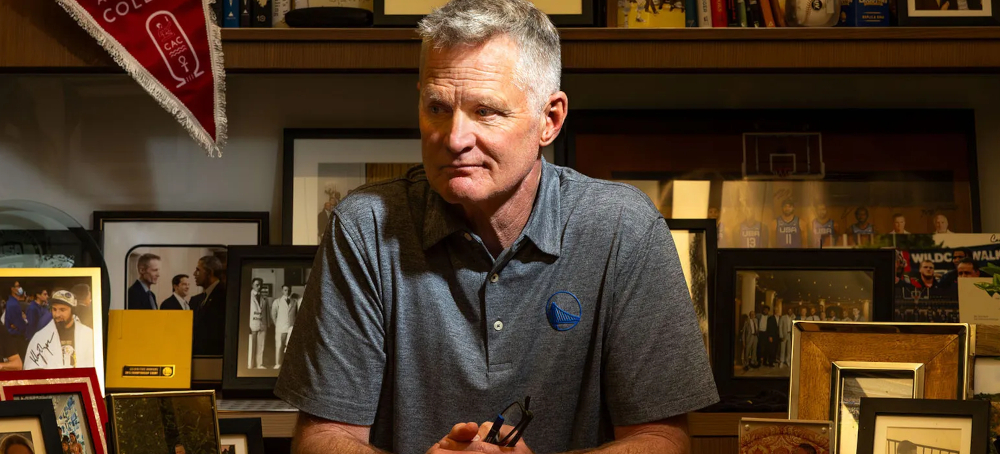 The head coach for the Golden State Warriors Steve Kerr. (photo: Christie Klok/The New Yorker)
 Charles Bethea | Has Steve Kerr Had Enough?
Charles Bethea The New York Times
The head coach for the Golden State Warriors on his future with the team, his complicated relationship with Draymond Green, and whether he might give politics a try.
Butler’s A.C.L. tear, back in January, effectively doomed Kerr’s already slim chances of winning a tenth title with a graying core of star players. Ten rings would put him just three behind Phil Jackson, who was Kerr’s coach on the nineties Chicago Bulls team that became the N.B.A.’s first truly global brand. It was easy to miss Kerr back then—a slim six-foot-three guard coming off the bench, good for a couple of threes, no dunks. Then he hit the game-winner with six seconds left to seal the Bulls’ fifth title, in 1997, and made a daring little joke at Jordan’s expense during the subsequent victory parade. “Phil told Michael, he said, ‘Michael, I want you to take the last shot,’ ” Kerr began. “Michael said, ‘You know, Phil, I don’t feel real comfortable in these situations. So, maybe we ought to go in another direction. Why don’t we go to Steve?’ So I thought to myself, Well, guess I’ve got to bail Michael out again.” Jordan, famous for taking things personally, just chuckled.
I met Kerr a few days ago at his modest office in the Chase Center, where the Warriors play, in San Francisco. He had just finished conducting his annual exit interviews with players, staff, and management, following the season’s end. A small wooden placard on his desk read “winning is good”—a joking riff, he explained, on the line from “Animal House” that “knowledge is good.” The office’s whiteboard walls, frequently covered in a granddaughter’s doodling, noted Kerr’s “core values”: “competitiveness, joy, mindfulness, compassion.” There were also a few roller bags, about which Kerr—whose contract just expired, and whose future with the organization is an open question—only said, “It’s a long story.” Over the course of two hours, we discussed his hopes for next year, his complicated relationship with Draymond Green, the potential benefits of eliminating the three-point shot, and whether he might give politics a try. Our conversation has been edited and condensed.
I don’t typically sleep in the childhood bedroom of my interview subjects, but your mom, Ann, was kind enough to host me in yours, in L.A., in 2018, when I wrote a piece about her for the magazine. Now in her nineties, Ann is the director of the Fulbright Visiting Scholar Program in Southern California, a lover of Middle Eastern culture, a morning swimmer, a rope swinger, a memoirist, and, as she says, the mother of “two Ph.D.s, an M.B.A., & an N.B.A.”
[Laughs.] That’s her line.
I was saddened to learn that the house where I stayed, and where you grew up, burned in the Palisades Fire. What was your childhood like there?
Man, what a place to grow up: Pacific Palisades. My dad was a professor of Middle East politics and got the job at U.C.L.A., and we lived in a couple of other houses before my parents found that house. It’s got a panoramic view: Los Angeles all the way up to Malibu and the ocean. It’s amazing. Today there’s no way a professor at U.C.L.A. could afford it. A very different time economically, different time politically.
Ann mentioned coming home from a weekend away, during your teen-age years, to find that her potted plants smelled like beer.
That would have been when I was in high school. And, yeah, I may or may not have authorized a party for all my friends and forty or so extra people.
The family also spent time in Cairo and Beirut, where you were born.
Mostly in the Palisades with intermittent sabbaticals from my dad. We spent time in, let’s see: a year in Aix-en-Provence, in the South of France, when I was in kindergarten; three years in Cairo. Then back to L.A. When I returned to Cairo, for ninth and tenth grade, my dad was doing research and writing a book and teaching at the American University in Cairo.
Was there a basketball culture in Cairo then?
I went to an American prep school called Cairo American College. I still have great friends from there. For ninth and tenth grades, I played on the school team. Every year we would fly to Greece, to Athens, to play in the tournament against other schools in the region. That was the highlight. This would have been, like, 1979, 1980. If there was a basketball gym in the entire country of Egypt, we never found it. So our games were played on dirt courts. Basketball was not really popular in Cairo, but these sporting clubs would field men’s teams and we usually were playing against players a lot older than us. And bigger. But we had the advantage because we all grew up playing basketball. The inverse was true in soccer. The American kids would take on the Egyptian kids at our school and we would just get absolutely destroyed.