
California to Vote on Landmark Tribal Petitions for Coastal Protections
Claire Barber Inside Climate News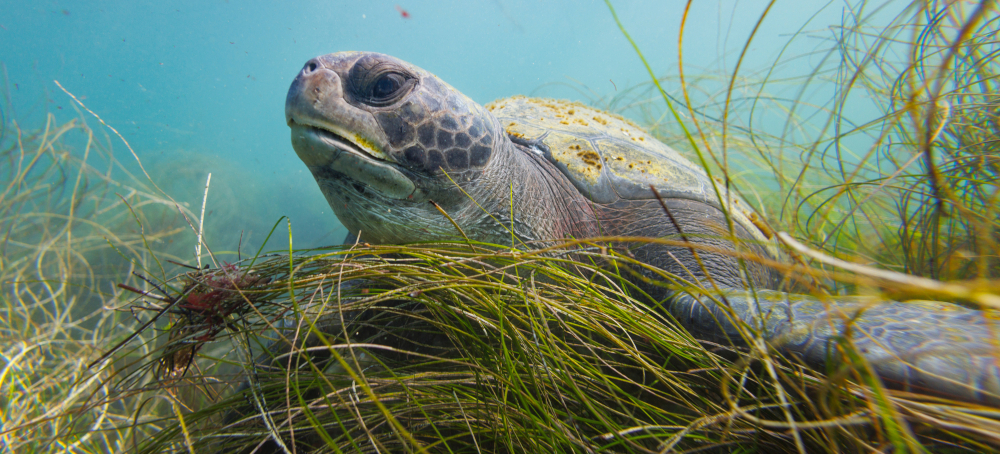 A green sea turtle swims in the Matlahuayl State Marine Reserve off the coast of La Jolla in San Diego. (photo: Kevin Carter/Getty)
 California to Vote on Landmark Tribal Petitions for Coastal Protections
Claire Barber Inside Climate News
The state is set to decide on a slew of proposed changes to its network of marine protected areas this fall, but how co-management between the state and tribes would proceed is unclear.
But this fall, the California Fish and Game Commission will vote on a set of tribal petitions to amend the state’s network of marine parks, marking a potential shift in the state’s management of marine resources.
California’s coastline is home to 125 marine protected areas, a system of underwater parks established to protect and enhance biodiversity in the state. After over a decade of use, data shows that the network is working to enhance biodiversity and climate resiliency, but for years the state has agonized over the next steps it should take to manage the network.
In 2023, the California Department of Fish and Wildlife and Fish and Game Commission allowed the public to submit petitions for change—a process which drew criticism from all sides, much of it over fishing access and ecological benefits. Of the 20 petitions received, five are tribally led or co-led and seek to protect heritage sites, specific species and tribally important ecosystems. The tribal petitions are significant because tribes were left out as formal stakeholders when the Marine Life Protection Act, which guides the network, was passed in 1999.
While all of the petitions—tribally led or otherwise—are subject to the same level of scientific scrutiny, the tribal petitions represent a new thread of government-to-government consultation between tribes and the state of California in the management of marine resources. “ I suspect my fellow commissioners will give real deference to what the tribes are looking for and what their concerns are,” said Eric Sklar, president of the California Fish and Game Commission.
Conflicting Recommendations
The commission’s members will consider evaluations from two state agencies, both the California Department of Fish and Wildlife, which manages marine protected areas, and the Ocean Protection Council, which sets policy priorities for the network, as well as public comments, in casting their final votes.
Importantly, the recommendations from the department and council have drawn attention, since they differ in what next steps they suggest the commission take.
Of the five tribal petitions, three propose establishing new marine protected areas outright, while two request tribal harvest exemptions for specific species without the creation of a new protected area. For these tribal “take,” or fishing exemptions, both the council and department generally agree that the measures should be approved.
“Traditional harvest has so much more behind it,” said Rachel McCain, Natural Resource Department director for the Tolowa Dee-ni’ Nation. “It’s tied to culture and life ways and existence and identity. It’s way deeper than just catching fish.”
The Nation has requested that true smelt, which have been in decline for years, be limited to tribal take only within the Pyramid Point State Marine Conservation Area near the Oregon border.
But other requests for change are not as cut and dry. The Department of Fish and Wildlife recommends denial of the newly proposed tribal marine protected areas, while the Ocean Protection Council recommends approval of all but one proposal.
“ OPC’s recommendations reflect the best available science wherein they are very seriously considering how it is that they can make the MPA network more resilient to the impacts of climate change and protect some of the state’s most vulnerable habitats, like persistent kelp forests,” said Sandy Aylesworth, director of the Pacific Initiative, Nature, at the Natural Resources Defense Council. “And then CDFW’s recommendations, on the other hand, really read as if they are interested in entrenching decisions of the past.”
The conflicting recommendations reflect, in part, how the agencies serve different purposes. The department is tied to an evaluation framework established by the Fish and Game Commission in 2009, which outlines scientific metrics and ecological spacing that a protected area should meet. The council, on the other hand, is tasked with evaluating the network on far more flexible policy priorities to advance the Marine Life Protection Act.
The council’s recommendations are “intended to complement the comprehensive evaluations that the Department of Fish and Wildlife conducted under a separate set of questions and criteria,” said Jenn Eckerle, executive director of the Ocean Protection Council. The council, she said, approached its evaluations through a precautionary principle, considering worsening climate scenarios.
“… Our MPA network is one of the most effective conservation tools for safeguarding biodiversity and building climate resilience and protecting our $51 billion coastal economy and so it’s through that lens that we assessed the petitions,” she said.
Still, the differing recommendations have caused some confusion among stakeholders, especially in what new marine protections would look like. The department did not simply recommend denial of the new tribal marine protected areas, but suggested the state explore an entirely new designation under state parks, called “State Marine Cultural Preservation Areas.” This designation would require an entirely new process outside of the department’s purview, and caught tribal stakeholders off guard.
“We do not know that [State Marine Cultural Preservation Areas are] even a valid or legitimate option, because at this point, state parks has not said that they would do it or that they could do it. And so they’re kicking the can down the road to another agency,” Violet Sage Walker, chairwoman of the Northern Chumash Tribal Council, said.
State Marine Cultural Preservation Areas are intended to protect non-living cultural heritage sites. The state has yet to establish or manage one, so it remains unclear what would happen if the Fish and Game Commission voted to support their implementation.
Uncertainty Over Co-Management
Another key to the creation of tribally led and co-led marine protected areas is deciding what management between the state and tribes or “co-management” would look like. “Were all just figuring it out as we go,” said Sklar.
The Santa Ynez Band has proposed three new protected area sites through the amendment process, one of which—the Mishopshno MPA proposal in Santa Barbara—is the site of the Chumash creation story and traditional canoe-building sites.
“Being able to co-manage an area doesn’t just give you access, it gives you the ability to have decision-making power,” said Eva Pagaling, co-founder of Ocean Origins and community member of the Santa Ynez Band of Chumash Indians.
Pagaling grew up paddling and building traditional redwood canoes with her father in the coastal waters of Santa Barbara.
“ Co-management is extremely important because of the cultural significance,” Chairman Kenneth Kahn of the Santa Ynez Band of Chumash Indians said. “Our tribe has been connected to the multiple areas that we’re trying to preserve since time immemorial.”
Both the Santa Ynez Band of Chumash Indians and Northern Chumash Tribe have recommended that the state pursue co-management outside of the marine protected area framework, but it is still undecided how co-management of resources would occur if tribal marine protected areas were approved.
“We don’t need any change to state law to do it. We’ve just got to sit down with each individual tribe, and figure out what that means to them,” Craig Shuman, marine region manager for the California Department of Fish and Wildlife, said.
What is clear is that the tribally-sponsored marine protected areas would be the first of their kind in California, as the United States systematically weakens marine protections federally.
“It’s been a long and complicated process, but I’m really pleased that we were able to get input from so many members of the public, from the department, from the OPC and from the tribes because that’s what this is all about,” said Sklar, the Fish and Game Commission president.
The commission will vote on their recommendations to advance or deny the tribal petitions the week of Oct. 15.