
Bison to Roam U.S.-Mexico Borderlands for First Time in 200 Years
Nina Kravinsky KJZZ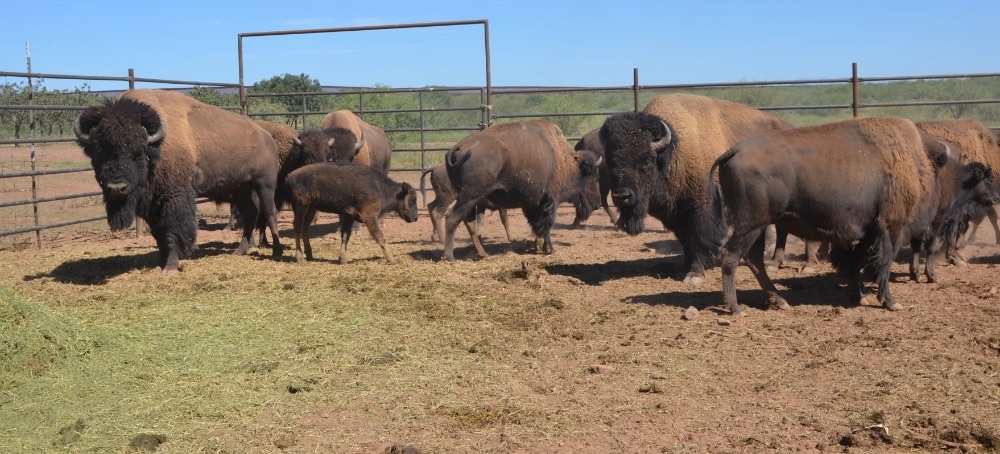 This herd of American bison will become the first to roam in the Mexican state of Sonora is around two centuries. (photo: Nina Kravinsky)
 Bison to Roam U.S.-Mexico Borderlands for First Time in 200 Years
Nina Kravinsky KJZZTheir calves, now a few months old, have tiny pointed horns, like miniature versions of the adults’ stately curved ones. They were born on the Cuenca Los Ojos nature preserve, a more than 120,000 acre swath of land just south of the U.S.-Mexico border.
“The vision we have is that bison will roam here and do whatever they want to do,” Cuenca Los Ojos Conservation Director Peter Winsor said. “And there will be prairie dogs and pronghorn and elk and anything else that has an ecological function here that used to be here that were removed, mostly by habitat destruction and human hunting.”
This is the Sky Islands region, where Sonora meets Chihuahua to the south, and Arizona meets New Mexico to the north. Deserts, grasslands and complex mountain ranges flow into one another to become one of the most ecologically diverse places on earth.
The reintroduction of native species is part of Cuenca Los Ojos’ vision to restore the land on the southern side of the U.S.-Mexico border. Introducing species that used to be here — like bison, elk and prairie dogs — will have ripple effects on the rest of the ecosystem, Winsor said. The organization is working to rewild their massive swath of land in Sonora, even as a man-made border wall lengthens across the preserve’s northern border.
The binational nonprofit brought this bison herd to Sonora from federally protected land in neighboring Chihuahua, where the bison population had grown into the hundreds after a U.S. donation of 23 animals in 2009. Those bison came from Wind Cave National Park in South Dakota.
When the wild bison of Cuenca Los Ojos have free rein on this habitat, likely within the next few weeks, it will be the beginning of a trickle-down effect, Winsor said.
As bison range long distances, they carry seeds in their dung and hair. Their uneven grazing creates habitats for birds and small mammals in the grasslands. When bison die, their carcasses provide protein for scavengers and the soil. It’s a pattern that conservation biologist Curtis Freese has studied and observed for years as he’s worked to reintroduce bison elsewhere.
“That’s all part of this big vision of bringing back a self-sustaining ecosystem that requires minimal human intervention to keep it going,” Freese said.
Freese is a co-founder of American Prairie, a nonprofit nature reserve in Montana, which reintroduced bison several years ago and aims to connect public lands to create wildlife corridors. He now consults Cuenca Los Ojos on its bison reintroduction program.
In these remote borderlands, Cuenca Los Ojos sits to the north and south of other large tracts of protected land. Winsor and Freese hope there will eventually be more connectivity between all of those areas.
“You’ve got this whole chain of wildland and rewilding ideas underway, and all of them depend on big intact areas that get connected with each other, one way or the other,” Freese said.
Freese and Winsor are dwarfed by the towering, rust-red border wall behind them. The U.S.-Mexico divide makes up the northern border of Cuenca Los Ojos, but not all of it is walled. Some sections of the border are marked with a low vehicle barrier. In other parts, there’s no barrier at all. But as the Trump administration seeks to stretch the border wall from the Pacific Ocean to the Gulf of Mexico, that is changing.
As Winsor’s vehicle hurtles down the pothole-studded Sonoran highway parallel to the snaking border wall, he tries to explain just how big the preserve is.
“The big mountain ranges in the way back there, that are kind of hazy blue? That’s still Cuenca. And the next mountain range over is still Cuenca. So it sort of goes and goes,” Winsor said.
Due east, hills begin to rise around the road. Grasslands quickly become mountains. Jagged rock formations punctuate the rugged terrain.
It's an ideal habitat for the many species of wild cats that stalk this land, generally under the cover of night, like pumas, ocelots and bobcats. Cuenca Los Ojos has also captured images of jaguars on wildlife cameras. Recent ones indicate this area could be the northernmost breeding population of the elusive, almost mythical felines.
The largest cat species in the Americas needs vast tracts of uninterrupted land to roam.
But the lengthening border wall is increasingly threatening their ability to move here. From the highway, gashes of cleared land are visible deep in the mountains where construction workers are making way for more border wall.
Deep in a valley, a spring-fed stream gurgles year-round, shaded by giant sycamores and cottonwood trees. Nearby wildlife cameras show a “fantasy football team” of predators — like ocelots, jaguars and bobcats — all converge right here, Winsor said.
“This kind of habitat is rare nowadays,” Winsor said.
Around 30 years of waterway restoration has laid the groundwork for the rewilding project Cuenca Los Ojos is now undertaking, Winsor said.
The conservation organization has spent decades transitioning what were once cattle ranches into more natural habitats by taking down fences and strengthening the watershed. Secluded, green corridors that snake through the rugged terrain are a lifeline for many species, Winsor said.
“Jaguars are coming up here on their own, and finding a habitat that’s suitable is due to the water availability and vegetation,” Winsor said.
Jaguars and other large, predator species can play an outsized role in the environment, even in small numbers, by keeping the populations of other species under control.
Similarly, grazing animals, like bison, are critical to keeping the grasslands intact — especially as Cuenca Los Ojos transitions its land out of cattle grazing. Bison are just the first on a long list of native species Cuenca Los Ojos is hoping to reintroduce here.
The organization is trying to restore the resident beaver population to help moderate and strengthen its streams and waterways. Eventually, it hopes to introduce prairie dogs, elk, even grizzly bears, Winsor said, “like a modern 2026 Jurassic Park.”
“Hopefully this goes better,” Winsor joked.
Healthy populations of those species strengthen life up and down the food chain, from microbes in the soil to the hawks in the sky, Winsor said.
“If you take them out, which has happened here, it’s like trying to do a domino effect but you’re missing 10 dominoes. So it’s not going to keep going,” Winsor said. “We want to put those back.”
Back by the bison and the border wall, grasses made tall by recent monsoons grow past knee-length.
As the border wall stretches longer on Cuenca Los Ojos, wildlife cameras show animals unable to cross, despite the small wildlife openings cut into the 30-foot border wall.
Conservationists like Winsor fear the planned double wall in some areas will make it even harder for animals to move. The existing 30-foot border wall at much of Cuenca Los Ojos’ northern border was built during the first Trump administration, and the second Trump administration is working to expand it.
Winsor hopes a future administration will want to make changes.
“Our whole rewilding idea on this side now is we’ll get the most biodiversity and the healthiest ecosystem and the best mix of animals we can possibly get,” Winsor said. “Hopefully, in the future … we can also help the government, if they ask us, to say, ‘These are hotspots where animals are trying and trying and trying again to cross, so this would be a great place to take a torch to this wall and cut a big hole.’”
Nearby, Cuenca Los Ojo’s new bison herd ambles in their pen, preparing to do what generations before them have done: roam.
For now at least, the red wall looming in the distance will be their northern border.