
Beware the Lame Duck
Bobby Ghosh Substack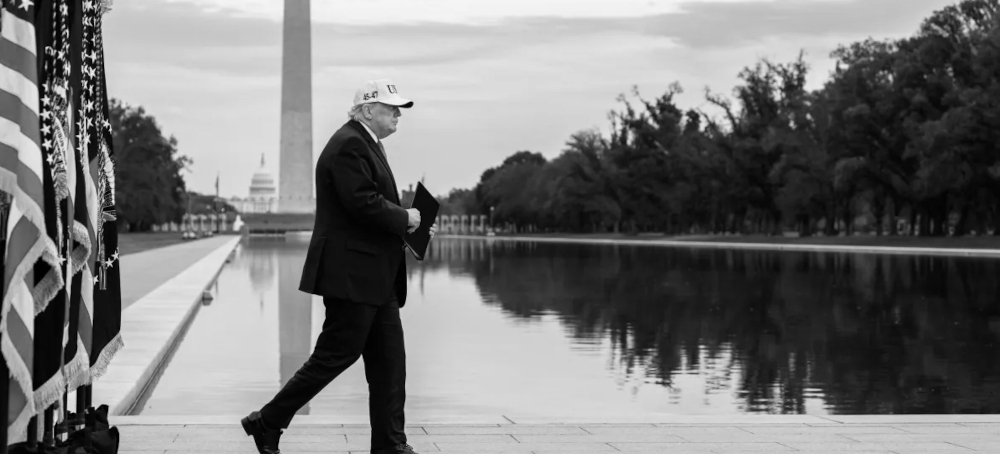 President Donald Trump in front of the reflecting pool. (photo: Getty)
Beware the Lame Duck
Bobby Ghosh Substack
Presidents who lose at home usually use foreign policy to burnish their legacy. Trump may also use it to build his fortune.
Sen. Jon Ossoff, reelected in Georgia, used his victory speech to call Trump a “lame duck,” a term will be used a great deal over the next few days and weeks. In my neck of the woods — foreign policy — the phrase is usually accompanied by a frisson of anticipation.
Here’s why: A President who loses his grip at home usually heads abroad, where Congress can’t follow him. Most recent incumbents of the White House have made the trip, and Trump is unlikely to be an exception.
But, uniquely, he will be looking not only to burnish his political legacy but also, more than likely, to build up his personal fortune.
Political scientists have closely studied the tendency of Presidential lame ducks to migrate from domestic issues to foreign policy. Philip Potter, writing in Presidential Studies Quarterly in 2016, found that Presidents in their final stretch use military force more often and conclude more international agreements. A President who can no longer pass bills still wants a legacy, Potter argues, and foreign policy is where he can act alone.
Daniel Drezner and Elizabeth Saunders, in Foreign Affairs this week, count two kinds of lame duck. One is a President in the weeks between his successor’s election and inauguration. The other, which Trump became on Tuesday, is a second-termer after his last midterm.
Whether lame ducks do any better abroad is less clear. Kyle Haynes studied crises started by presidential democracies since 1945 and found that whether a leader could run again made no visible difference to how they ended. Commentators like Daniel Larison have argued that the attention late-term Presidents bring to foreign policy doesn’t necessarily lead to better outcomes.
I spent the morning studying some of the more obvious examples of the trend:
* On January 3, 1961, with John F. Kennedy’s swearing-in less than three weeks off, Dwight D. Eisenhower slammed the door on Cuba. He also left his successor a CIA plan to overthrow Castro. Kennedy approved it, and the invasion sank at the Bay of Pigs in April.
* In December 1988, a year after Congress had declared the PLO a terrorist organization, and with his vice president already elected to succeed him, Ronald Reagan authorized the first official U.S. talks with it, ending 13 years in which Washington had refused. Secretary of State George Shultz worked out the terms largely on his own; Israel’s prime minister was indignant.
* George H.W. Bush lost reelection in November 1992 and, on the eve of Thanksgiving, decided to send about 28,000 troops to Somalia to protect famine relief. Bill Clinton inherited the mission, and after 18 Americans died in Mogadishu in October 1993, he brought the troops home.
* Clinton signed on to the International Criminal Court on New Year’s Eve 2000, the last day the treaty was open for signature. George W. Bush’s administration later unsigned it, a verb diplomats had rarely needed before.
* Two months after Democrats took both chambers in 2006, Bush sent 21,500 more troops to Iraq. Congress couldn’t stop him. After Barack Obama’s election in 2008, his administration signed an agreement requiring every American soldier to leave Iraq by the end of 2011, setting the kind of timetable Bush had refused for years to accept.
* Obama spent his last two years thawing old feuds — and starting a new one. Six weeks after Democrats lost the Senate in 2014, he announced he would restore relations with Cuba, and the next year he concluded the Iran nuclear deal. After the 2016 election, he ordered out 35 Russians the White House called intelligence operatives and barred Moscow from properties it owned in Maryland and New York, citing election interference.
Some other examples: Lyndon Johnson, having quit the 1968 race, halted the bombing of North Vietnam days before the election; Jimmy Carter spent his last weeks negotiating with Iran for the hostages, who flew out minutes after Reagan took the oath; Bush Jr. pushed NATO to open its door to Georgia and Ukraine; at Bucharest in April 2008 the alliance declared that both would one day join, and Russia invaded Georgia four months later.
Your views on those policy decisions may depend on your politics. But this much is unambiguous: None of those presidents was making money from foreign governments while he made those calls.
Trump is altogether different. PBS tallied eight new overseas ventures for the Trump family firm in roughly the first year of his second term, and the biggest deal landed days before the inauguration, when interests tied to Sheikh Tahnoun bin Zayed, the UAE’s national security adviser, agreed to pay $500 million for a 49 percent stake in World Liberty Financial, the family’s crypto venture. A lawsuit filed last month claims Trump unlawfully pocketed gains from more than $2 billion in crypto transactions involving foreign money.
Future scholarship on the lame-duck period of the Trump presidency will not only examine the impact of his foreign policy decisions on international affairs, but also calculate the income they yield his businesses. We should keep an eye on that aircraft carrier, of course — but we should also follow the money.