
Awaiting Justice: The Impact of Hong Kong’s National Security Laws
Adolfo Arranz, Dea Bankova, Jessie Pang, James Pomfret and Sudev Kiyada Reuters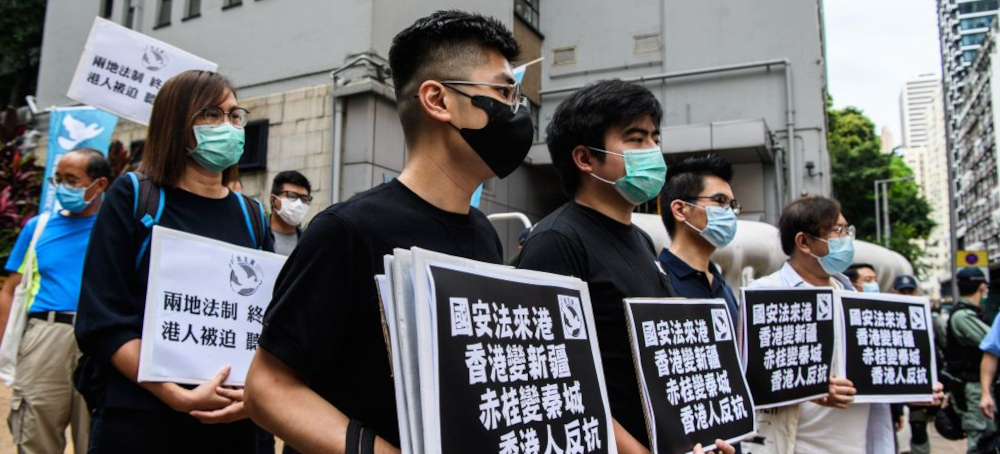 Pro-democracy protesters hold placards that translate as "National Security Law comes to Hong Kong, Hong Kong becomes Xinjiang, Stanley Prison becomes Qincheng Prison, Hong Kongers Revolt" as they march from outside the Western Police Station to the Chinese Liaison Office in Hong Kong on May 22, 2020. (photo: Anthony Wallace/AFP)
 Awaiting Justice: The Impact of Hong Kong’s National Security Laws
Adolfo Arranz, Dea Bankova, Jessie Pang, James Pomfret and Sudev Kiyada Reuters
How Hong Kong’s national security crackdown stifled the city’s democratic opposition.
The Post-it notes in this story depict these cases against activists, politicians, lawyers, students and journalists. The news agency was unable to find information for the other 148 cases.
Of the 238 cases, 127 have been sentenced so far, with an average prison term of more than three-and-a-half years, Reuters found. The average time from arrest to sentencing for 34 defendants who pleaded not guilty and have been convicted was two-and-a-half years. At least 136 of those charged applied to court for bail, Reuters found.
Of those 80% had their petition denied. Another 81 were released by police and have not yet been charged. Just five of the 238 cases Reuters examined resulted in acquittals so far, the news agency found. Reuters is the first news organisation to systematically review the scope and severity of the crackdown.
In November 2024, 45 of the city’s most prominent democrats were sentenced for between four and 10 years for conspiracy to commit subversion, related to their attempts to organise an unofficial “primary” election. Two among the group, which is known as the Hong Kong 47, were acquitted.
Subversion is a widely used charge for alleged national security offences. In total, Reuters found 68 convictions for subversion offences, carrying an average sentence of over five years.
Over 60 civil society organisations - including labour unions, political parties and media organisations - have disbanded since the national security law was imposed by Beijing in 2020, according to a Reuters tally, with many of them citing pressure from authorities as the reason for closure.
These arrests are placing a continuing strain on Hong Kong's judicial system and have drawn criticism from the United Nations human rights body.
In response to Reuters questions about national security cases, a Hong Kong government spokesman said “laws must be obeyed and lawbreakers be held accountable,” while stressing that enforcement actions had nothing to do with the “political stance, background or occupation” of an individual, and that all defendants receive a fair trial.
China’s main representative ‘Liaison Office’ in Hong Kong did not respond to a Reuters request for comment about the legal crackdown on the 2019 protesters including the national security cases. Lin Jian, a spokesperson with China’s foreign ministry, told reporters after the Jimmy Lai sentencing that Hong Kong’s judiciary fulfilled its duty to safeguard the law and national security. “This is justified, legitimate, lawful and allows no interference,” he said.
Hong Kong’ s Security Bureau declined to disclose detailed data about the 386 cases, citing a need to safeguard national security.
Around 260 of the national security cases had reached court by December, according to figures released by Hong Kong’s judiciary. At least 2,370 other cases the judiciary defines as being related to the 2019 protests have also reached the courts since 2019, the judiciary said in a statement to Reuters. Those cases mainly include lesser charges for offences such as rioting and unlawful assembly.
Reuters could not establish how many more cases the protests, new laws and crackdown had added to the overall workload of the courts compared to previous years, but the judiciary said this “upsurge of social event” cases had posed “challenges”. It told Reuters that 90 protest-related and national security cases were outstanding, with the majority listed for trial in 2026.
“The Judiciary expects to see continual and steady improvements to waiting time,” it said.
At least 101 people, among the 238 arrests reviewed by Reuters, were charged with sedition, considered a national security offence. The charge was not part of the 2020 national security law. Authorities instead initially charged people, including Lai, under a British colonial-era law, until Hong Kong drafted stricter sedition legislation in 2024.
Sam Chan, a 24-year-old former leader of Student Politicism, a pro-democracy student group, was sentenced to 34 months jail in September 2021 for conspiracy to incite subversion of state power after setting up a street booth with three others.
“My name is Chan Chi Sum Sam and I was charged with conspiracy to incite subversion because I ran a student group called Student Politicism and I was expected to be arrested but I wanted to still speak out. ”
The group had referenced the popular protest slogan, "Liberate Hong Kong, Revolution of our Times", which could mean separating the city from China and inciting secession, the judge in the case said.
Chan says he has struggled to regain his footing since being released early from prison in 2023 after 22 months for good behaviour. He originally wanted to become a social worker, but gave up after a 2024 Hong Kong rule that permanently bars those convicted of national security crimes from getting a social worker licence. He’s now studying for a media and culture associate degree in Hong Kong.
Like Chan, a dozen former inmates released after serving national security sentences told Reuters they face continuing pressure from authorities, including visits from the national security police to their workplace causing dismissals from employment, stringent monitoring by authorities after their release, and restrictions on free speech and travel.
Seven of those told Reuters they too face hurdles finding schools, and jobs in education, law, and the civil service, and are barred from holding any public office under the national security law.
“There are still many who are paying the price,” Chan said. Reuters was unable to independently verify the accounts of Chan and the other former inmates.
The government spokesman said Hong Kong would respect and protect human rights while safeguarding national security, and said post-release “supervisions services” were intended to “help inmates lead a law-abiding and industrious life after release”. He did not respond directly to questions about Chan’s case or the ongoing professional restrictions on people convicted of protest related crimes.
Only five of the 238 cases studied by Reuters resulted in an acquittal and one of those faced an appeal from the prosecution a month after the verdict. At least 127 received prison sentences. Around 54 of those have since been freed.
“All cases are handled strictly on the basis of evidence and in accordance with the law. All defendants will receive fair trial strictly in accordance with laws applicable to Hong Kong,” the government spokesman said.
Court and police data shows that the arrests and prosecutions continue, despite international criticism from Western democracies, rights groups and the U.N human rights agency that the broad scope of the laws risks outlawing legitimate civil society activities.
Chan Kim Kam, 38, was one of the first people arrested in Hong Kong under the revamped sedition law, part of a second package of national security laws enacted in 2024 known as Article 23 . She and several others were accused of publishing posts with “seditious intent” related to the 1989 Tiananmen crackdown.
Although she hasn’t been charged, Chan, in an interview with Reuters, said she has lost several jobs due to the fallout of her arrest and now has to report to a police station weekly. “Is it really necessary to kill off a person’s survival space in Hong Kong?” she asked rhetorically. “It’s a kind of suppression targeting people with certain political backgrounds.”
Of the 101 sedition offences, 25 came under the 2024 package of laws, making sedition the most common charge Reuters found under Article 23 laws.
Of those, at least eight have led to convictions, with prison sentences of eight to 14 months, for acts that include social media posts and scribbling slogans on toilet doors, the court judgments show. The maximum sentence for sedition was increased to 7 years, and to 10 years if the offender is found to have colluded with an external force, from a maximum two years under the colonial-era law.
Other offences Article 23 punishes include treason, espionage and external interference, which targets any meddling in Hong Kong's affairs by foreign entities including governments and other groups.
Continued pressures
Chan Kim Kam told Reuters she lost a part-time job at a teaching institution after her employer was sent a letter that included links to news reports about her arrest. She was also forced to leave an amateur drama group where she acted in her spare time, after authorities told the group to replace her or risk losing access to a venue, she said. In September, she said she had to close a small shop in a mall selling aromatherapy products after the landlord refused to renew her lease.
“Things I wanted to do are no longer possible,” Chan said. “This is a pretty big blow.” In response to a request for comment, the drama group corroborated Chan’s account. The mall and the teaching institute did not respond to Reuters questions.
The Hong Kong government spokesman didn’t respond to questions about Chan.
More recently, Hong Kong police have used the laws against new acts perceived as protest. In November, police detained Miles Kwan, a university student, for alleged sedition after he started a petition demanding greater accountability for a deadly apartment block fire that killed at least 168 people. He was later released on police bail, according to a Reuters witness. The police said in a reply to Reuters regarding Kwan’s case that they would take actions according to actual circumstances and in accordance with the law.
In February, Kwan was expelled before his graduation from the Chinese University of Hong Kong (CUHK) after a student disciplinary committee meeting to follow up on the case, he told Reuters. Kwan cited the panel, which said no penalty would be imposed as a direct consequence of his arrest.
However, he said the panel gave him two demerits for breaching the confidentiality of the meeting — conduct they argued could harm the university’s reputation — and for displaying an impolite and disrespectful attitude toward the panel. Combined with his two previous demerits, the panel unanimously decided to terminate his studies.
The university said it would not comment on individual cases, adding that a student given three demerits due to disciplinary actions may be terminated from studies at the University. “Since my arrest by the national security police, I have known that the road ahead will not be easy, ” Kwan said. “Academic results could be taken away, but dignity cannot.”