
As Defence Chiefs, We Must Warn You About Russia and Say This: Rearmament Is Not Warmongering
Richard Knighton and Carsten Breuer Guardian UK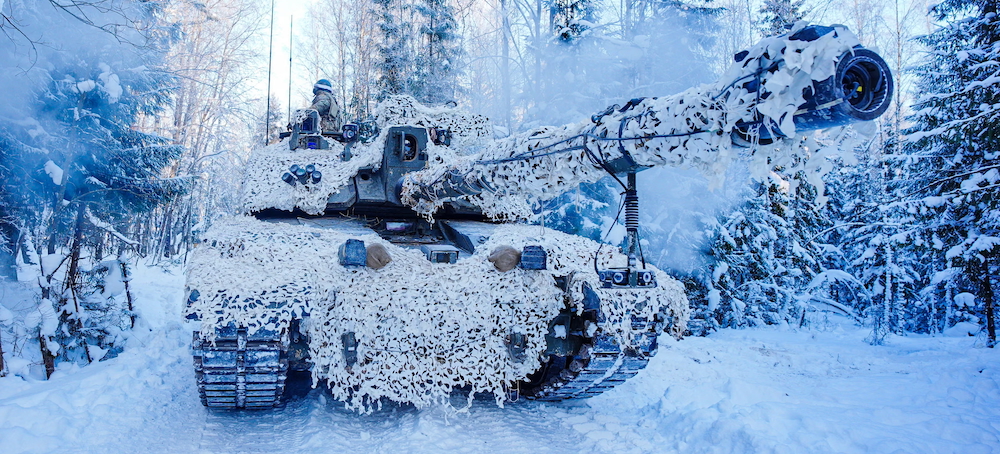 A British Challenger 2 tank in arctic camouflage takes part in a Nato exercise in Estonia, 2 February 2026. (photo: Ben Birchall/PA)
 As Defence Chiefs, We Must Warn You About Russia and Say This: Rearmament Is Not Warmongering
Richard Knighton and Carsten Breuer Guardian UK
Our security is more uncertain than in decades. But by working together, and by showing strength, Britain, Germany and the rest of Europe can preserve peace
As military leaders, we see every day from intelligence and open sources how Russia’s military posture has shifted decisively westward. Its forces are rearming and learning from the war in Ukraine, reorganising in ways that could heighten the risk of conflict with Nato countries. This is a reality we must prepare for; we cannot be complacent. Moscow’s military buildup, combined with its willingness to wage war on our continent, as painfully evidenced in Ukraine, represents an increased risk that demands our collective attention.
At the Hague summit last year, Nato leaders committed to spend 5% of GDP on defence and security by 2035. This reflects our new security reality and requires hard choices and prioritisation on public spending for all members.
As the chiefs of defence of two of Europe’s biggest security providers, we have a duty to explain what is at stake, so that people can understand why our governments have committed to the biggest sustained increases in defence spending since the end of the cold war. That’s why it’s important that we communicate the threat. People must understand the difficult choices governments have to take in order to strengthen deterrence.
History teaches us that deterrence fails when adversaries sense disunity and weakness. If Russia perceives Europe in this way, it may be emboldened to extend its aggression beyond Ukraine. Indeed, we know that Moscow’s intentions range wider than the current conflict. But the good news is that Europe is powerful. Nato is the most successful military alliance in history and today, together, its military might is unsurpassed. We have sophisticated capabilities across land, sea, air and cyber domains, and nuclear deterrence. And we have long been adapting to the new security reality: through building a new model for European security, underpinned by engagement, readiness and collaboration.
This starts with Britain and Germany deepening cooperation. Our landmark Trinity House agreement in 2024 is paving the way for unprecedented cooperation that benefits both our security and economies.
Military readiness must mean a strong European defence industry. Ukraine shows us that industrial bases are key to sustaining and ultimately winning any major war. The increased defence spending under way across our countries proves that we are taking this seriously, as we cannot deter if we cannot produce. Our industries must be capable of sustained output – manufacturing the ammunition, systems and platforms our forces require at the pace modern conflict demands.
Britain is building at least six munitions factories, which will generate an “always on” capability to sustain munitions stockpiles. Germany is permanently stationing an entire combat brigade to the eastern flank and has amended its constitution to make essentially unrestricted funding available for defence. Procurement of several thousand armoured vehicles has started, accompanied by an expansion of industrial capacity.
In addition, the European Union’s Security Action for Europe (Safe) initiative will inject €150bn (£130bn) to strengthen Europe’s defence industrial base.
There is a moral dimension to this endeavour. Rearmament is not warmongering; it is the responsible action of nations determined to protect their people and preserve peace. Strength deters aggression. Weakness invites it.
Finally, the complexity of threats demands a whole-of-society approach and an honest, continent-wide conversation with the public that defence cannot be the preserve of uniformed personnel alone. It is a task for each and every one of us.
Whole-of-society defence requires resilient infrastructure, research and development in hi-tech from the private sector, and national institutions prepared to function under increasing threats. The path ahead calls for courage and an honest conversation with our citizens. Europe’s security is our shared responsibility, and we intend to meet it together.
When Europe acts together, we are a formidable force. And we act together, we are not Great Britain and Germany alone.