
Apocalypse Now' in Gaza: Israel Seems to Have Its Own Unhinged Officers
Amos Harel Haaretz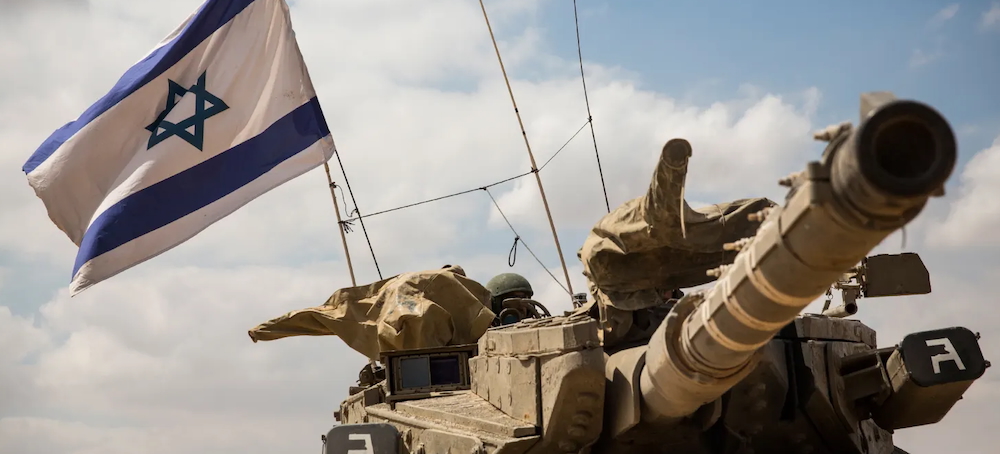 An Israeli tank in Gaza. (photo: Andrew Burton/Getty Images)
 Apocalypse Now' in Gaza: Israel Seems to Have Its Own Unhinged Officers
Amos Harel Haaretz
In a new book, a lieutenant colonel in the reserves tells about crazed soldiers and wayward officers who espoused the credo that 'revenge is legitimate in this war'
The soldiers set ambushes in the devastated urban landscape and open fire when they detect suspicious movements nearby. In the past two weeks the army has killed many dozens of Palestinians this way; some of them were carrying weapons.
The army told civilians in the neighborhood to leave, so the assumption is that anyone who approaches the forces is a terrorist. I asked the father whether he's convinced that Palestinian civilians haven't been hit. He's far from certain, but for now he has to concentrate on his son and his buddies succeeding in their mission and coming out alive.
By the way, this company has a Palestinian shawish, an Arabic word for servant or subordinate. The shawish combs through suspicious buildings, photographs them with a cellphone and sends the images to the unit. The Palestinian also performs various menial tasks. What he gets in return, if anything, isn't clear.
In August, when Haaretz reported about this practice, senior officers were appalled. The IDF Spokesperson's Unit said that running a shawish was forbidden, and that this had been made clear to the soldiers. The allegations were under examination.
Skepticism about the army's statements isn't limited to critics abroad, where the criticism is ramping up amid the killing in northern Gaza and the impossible living conditions in displaced persons camps in the south.
Three episodes are triggering serious doubts about the army's ability to investigate itself, report with transparency to the public and enforce its declared norms on the soldiers.
The three are the exploits in the Netzarim corridor of the commander of the 252nd Division, Brig. Gen. Yehuda Vach; the circumstances of the deaths of Golani Brigade soldier Gur Kehati and archaeologist Ze'ev Erlich during a visit to a Crusader fortress in Lebanon; and the controversy over the published recordings of the spotters murdered on October 7.
This is an immense challenge for Chief of Staff Herzl Halevi, who is preoccupied with the war in Gaza and the threats from the north, while the prime minister and the defense minister are concocting schemes to remove him. Still, Halevi's supreme obligation is to the public. This won't be realized without the whole truth being released.
An anthropological perspective
The gaze of some of the soldiers who experienced the horrors of October 7 "looked insane," writes Lt. Col. (res.) Asaf Hazani, "as if their eyes were covered by a thin veil. ... They simply looked through you.
"The main point is that those eyes don't allow interaction . ... The person who looks through those eyes is basically alone. That gaze can explain both Israel's insensitivity to the suffering in Gaza and the aggressive method of war adopted by the IDF."
Hazani, a reservist, served for many months at the headquarters of a division that fought in Gaza. In civilian life he's an anthropologist. The title of his new book translates as "One Way or Another the Sword Shall Devour – Anthropology in War: A Field Diary." It recounts his experiences in the war and joins a growing list of books on Israeli veterans of the conflict.
Much of the book is devoted to the early stages of the war in Gaza: the shocked IDF in light of the failures that led to the October 7 massacre, the horrific scenes in the communities near the Strip, the anxieties of the commanders as Israeli troops entered dense urban areas of Gaza, and the close-up fighting with Hamas, whose people fought from within the civilian population.
Regarding Hamas' cruelty on October 7, Hazani writes: "Hamas forced us to look at it and not deny its existence. … Hamas forced us to gaze at it as it is." The war "challenges us on the question of the limits of what is human, ours and theirs."
A person like that, he writes of the soldiers who fought on October 7, "sees nothing, not even the enemy. He is seized with revenge, and what is standing in front of him is ISIS, Nazis. … But revenge, we know, is blind."
Hazani saw this firsthand. He writes about the "war selfie," even by officers, already at the start of the war, even though they were warned that they were exposing their forces' location.
Many soldiers brought cellphones into Gaza, ignoring the army's directives. The book also confirms reports in Haaretz about the systematic burning of Palestinians' homes at the start of the war, even when this was unnecessary for operations, or the reason was invented later.
To his surprise, Hazani heard from senior officers he esteemed that "revenge is legitimate in this war." The public, he notes, often compares this war to the Yom Kippur War: a mistaken "conception" that led to disaster.
But in the military, the comparison is with the War of Independence: the conquest of territory deep within Israel, the feeling of a battle for survival, evacuated communities and civilians who were captured by the enemy such as in the Gush Etzion bloc and the Jewish Quarter of the Old City of Jerusalem.
Hazani noticed a nonstop "mission orientation" designed to cover the soldiers' and commanders' emotional abyss after the massacre. He writes about a special unit that since October 7 has begged to remain active, because the one time the unit took a break, the soldiers "lost it. … its options are to escape into carrying out missions or to go crazy."
In November 2023, a one-week cease-fire was declared to implement the first hostage deal, in which mostly women and children were returned. Hazani writes that only during that week did he understand, late and contrary to the general feeling in the division, that the freeing of the hostages was less due to Israeli military achievements and more due to Hamas propaganda. The organization wanted to get rid of the women and children, who were a burden including an image burden in the group's contacts with the international community.
A few weeks after the collapse of the cease-fire and the renewal of the fighting, the awful incident occurred in Gaza City's Shujaiyeh neighborhood in which soldiers accidentally killed three hostages who had escaped. Shock gripped the units, Hazani writes.
"What does it mean that the army wasn't prepared for a scenario like that?" he asks. "Until then there was an illusion, conscious or not, that when it came to achieving the war's goals, the army could have it both ways and operate both to topple Hamas and get the hostages back."
The ground forces "were busy with the ground offensive; the special units were busy locating the hostages and carrying out operations to rescue them. … Beyond the shock at this case, the goals of the war resoundingly clashed."
In that period, the character of the fighting also began to change, after the army quickly captured northern Gaza, Hamas' systems collapsed and many of its fighters fled. In the first stage, Hazani writes, "We hardly encountered the enemy or a civilian population."
Subsequently, "the fighting in Gaza started to look like Judea-Samaria 2.0: a long-term occupation, only bloodier. The friction with the population increased, and with it the enemy's actions. The enemy, whom we didn't encounter in the first stage and was described as contemptible or despicable, became a professional adversary that exploited our weak points and waged guerrilla warfare."
The cease-fire, and then the resumption of hostilities, brought with them phenomena like a home-front routine in areas that Hamas had withdrawn from. One day, at an entrance point into Gaza, Hazani noticed a surfboard dangling from an IDF vehicle.
"A day-camp atmosphere," Hazani writes. "I went over to the driver, who acted as if he didn't understand what the problem was. I dealt with the matter on my own. Whereas I was disturbed by this sight, which reflected a lowering of operational awareness, quite a few of the officers around me simply burst out laughing. 'What a guy,' they muttered."
Hazani leaves to the reader the association that springs to mind: the Americans in Vietnam and Robert Duvall's performance as Lt. Col. Kilgore, the commander of a helicopter squadron in "Apocalypse Now." That character is remembered for "I love the smell of Napalm in the morning," but he's also the officer who searches for a beach with good surfing for him and his men during a gruesome war in which a civilian population pays the greatest price.