
An O.M.B. Plan to Defund Science—and Anything Trump Doesn’t Like
Elizabeth Kolbert The New Yorker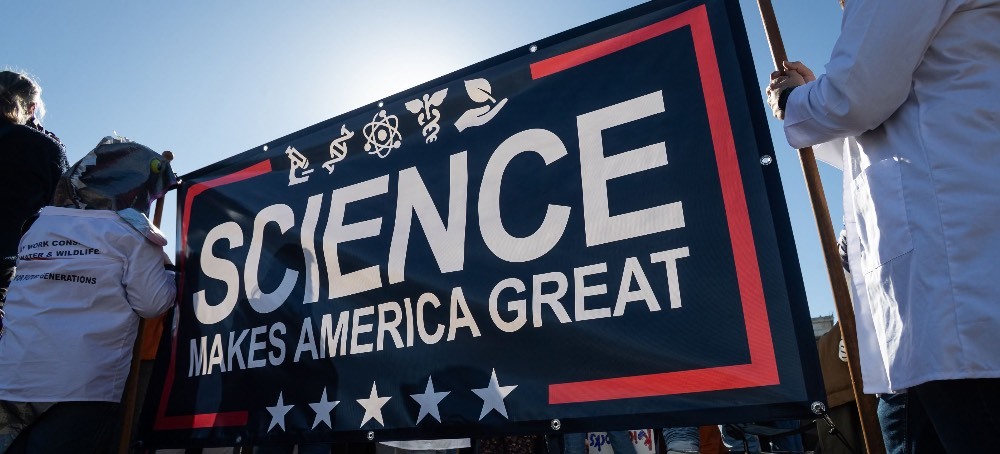 Protesters in Washington demonstrate against science funding cuts imposed by the Trump administration. (photo: Allison Bailey/Shutterstock)
 An O.M.B. Plan to Defund Science—and Anything Trump Doesn’t Like
Elizabeth Kolbert The New Yorker
Under a new proposal, Administration officials could deny government grants to any group or project on the ground that it didn’t fit the President’s agenda.
Recently, the White House announced plans to codify its campaign of retribution. The proposal, which would dramatically increase the President’s power over how federal funds are given out, would hand Trump a “new cudgel” to “advance his partisan agenda and punish political rivals,” a letter signed by all the Democrats in the Senate charged. “The stakes could not be higher” is how the legal website Lexology put it.
The proposal in question comes, not surprisingly, out of the Office of Management and Budget, headed by Russell Vought, the architect of Project 2025. Titled, innocuously enough, “Regulation for Federal Financial Assistance,” it would replace the current guidance for signing off on government grants, which generally leaves the task to civil servants and peer-review panels. Instead, the final say would go to political appointees. All discretionary awards from the federal government would have to be assessed by senior Administration officials, who could deny them on the ground that they didn’t fit the President’s agenda. Grants could also be terminated at any time for the same reason.
The rules would affect hundreds of billions of dollars in funding disbursed by agencies ranging from the National Endowment for the Arts to the Transportation Department, to pay for everything from local dance performances to massive infrastructure projects. As Elizabeth Ginexi, a former program director at the National Institutes of Health, noted in a recent Substack post, “Federal grants are not peripheral to how states and communities function. They represent, on average, 36 cents of every dollar a state spends.” The proposal, she added, would put the “entire financial partnership between the federal government and the states under political control, without an act of Congress.”
The O.M.B.’s stated rationale for the new rules is to “improve transparency, accountability and oversight for Federal awards.” But no one—and this includes Trump appointees—seems to be buying it. Trump’s nominee to be the O.M.B.’s deputy director, Hal Duncan, noted at his confirmation hearing last month that the proposal would enable the Administration to prevent federal money from supporting “divisive D.E.I. ideologies.” At the same hearing, Senator Patty Murray, Democrat of Washington, accused the White House of trying “to turn the entire federal government into this one big slush fund to reward those aligned with the Administration and punish everyone else.” Among the many groups that have expressed concern about the changes are the National League of Cities, the School Superintendents Association, and the National Council of Nonprofits.
Research organizations have been particularly outspoken in their opposition to the O.M.B. proposal. “This latest move is a brazen power grab by the Director of the Office of Management and Budget to buck the will of Congress and the American people and will make future discoveries less likely,” Sudip Parikh, the head of the American Association for the Advancement of Science, wrote recently. Among the proposed rules’ many provisions is one that would prohibit federal money from being used to support collaborations between researchers in the United States and their colleagues in many other countries. “By this guidance, America would not be allowed to be included in the International Space Station,” Colette Delawalla, who founded and heads the group Stand Up for Science, said in an interview. “The same goes for every type of weather monitoring and pandemic monitoring.”
Of course, even before the O.M.B. proposal was published, on the Friday after Memorial Day, the White House was finding plenty of ways to undermine science. Last year, the Administration terminated or froze nearly eight thousand research grants. Federal judges have ordered many of them to be reinstated; still, roughly a third, totalling some 1.4 billion dollars, have yet to be released, and may be gone for good.
For the current fiscal year, Trump proposed slashing the budget for the National Science Foundation by more than half. Congress rejected the cuts and essentially held N.S.F. funding flat; the Administration has responded by simply refusing to disburse the funds. According to the website Grant Witness, this year the N.S.F. is on track to make the lowest number of grants in more than half a century—roughly seventeen hundred. Meanwhile, the agency has been operating without a director for the past fifteen months. (Trump has nominated a financier with no scientific expertise to lead it, but the Senate has yet to confirm him.) And, in April, the President abruptly fired all twenty-two members of the N.S.F.’s science advisory board. It was dismantled just as it was working to finish an analysis showing that China has overtaken the U.S. as the leader in key scientific fields. The turmoil at the agency has affected scientists—and budding scientists—across the disciplines: recently, M.I.T.’s president, Sally Kornbluth, reported that the school’s graduate enrollment has declined by about twenty per cent. “It’s a loss for the nation,” Kornbluth said in a videotaped message to the campus. “When you shrink the pipeline of basic discovery research, you choke off the flow of future solutions, innovations, and cures.”
The O.M.B. is aiming to finalize the new regulations by October 1st. (This is the case even though the office has already received more than ninety thousand comments on them and, under the law, is supposed to respond to all significant points before they can take effect.) It’s no accident that Vought wants the proposal enacted before the midterms; this would allow the Administration to continue to terrorize grant recipients even if Democrats gain control of Congress and start to exercise real oversight. As the late Donella Meadows, a professor at Dartmouth and the author of “Thinking in Systems,” once observed, “Power over the rules is real power.”