
An Energy Bill That Plays Into Trump’s Hands
Elizabeth Kolbert The New Yorker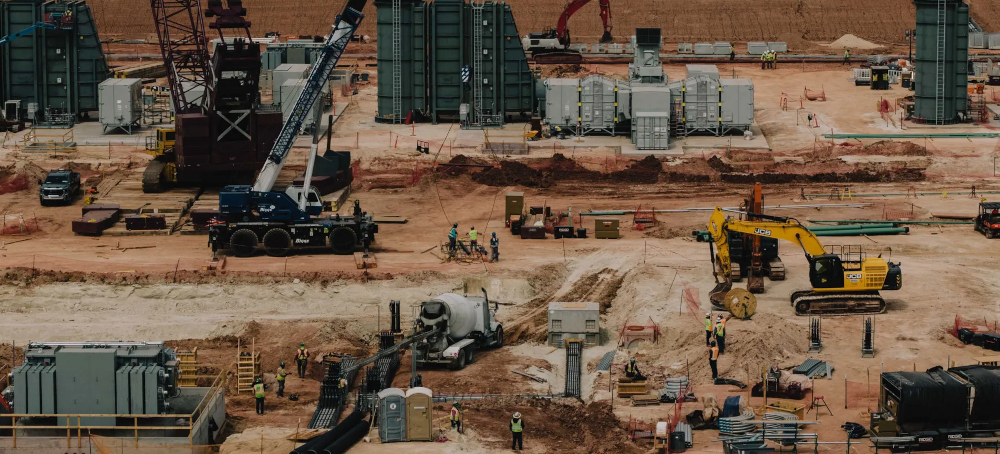 View of the data center being built on the Lancium Clean Campus in Abilene, Texas. (photo: Stephen Voss / Redux)
An Energy Bill That Plays Into Trump’s Hands
Elizabeth Kolbert The New Yorker
New legislation could speed up electrification—and the President’s preferred fossil-fuel initiatives.
Over the next few decades, the phrase became a bipartisan rallying cry. John McCain used it in his unsuccessful Presidential campaign against Barack Obama in 2008; then Obama took it up. Donald Trump embraced it, and so, too, did many of the Democrats who ran on anti-Trump platforms this year. James Talarico will “keep Texas the world’s energy leader with an all-of-the-above strategy that protects good-paying oil and gas jobs and grows wind, solar, and geothermal,” the senator-elect’s campaign website declared.
The Bipartisan American Affordability and Jobs Act (BAAJA), a.k.a. the Senate permitting bill, might perhaps more aptly be named the All of the Above Act. The four-hundred-plus-page bill would make it easier to obtain federal permits for a wide variety of energy and energy-related projects, including transmission lines, wind farms, natural-gas pipelines, data centers, and coal mines. The Senate is expected to take up the permitting bill before the weekend. If approved, the bill will then head to the House, where it’s unclear whether it has enough support to pass. Whether it should pass is even more doubtful.
BAAJA was negotiated by a quartet of senators: Shelley Moore Capito, a Republican of West Virginia; Mike Lee, a Republican of Utah; Sheldon Whitehouse, a Democrat from Rhode Island; and Martin Heinrich, a Democrat from New Mexico. The four—and many, many others—agree that the federal permitting process is too cumbersome, and that this discourages investment in many sorts of energy projects. High-voltage transmission lines, which are used to transport electricity over long distances, are a key illustration of the problem; the U.S. has been building such lines at the rate of about five hundred miles per year, when, it is estimated, five thousand miles’ worth per year are needed to meet the country’s growing demand. A lack of transmission capacity can, in turn, prevent electricity-generating projects from coming online, or even being built. BAAJA seeks to encourage the construction of transmission lines by, among other things, giving the Federal Energy Regulatory Commission (FERC) more power over planning for the country’s electrical grid. Proponents say that, by speeding the addition of transmission lines, the bill will also foster the construction of more carbon-free energy projects. “Removing permitting, transmission, and interconnection barriers would disproportionately accelerate clean energy deployment,” the trade group American Clean Power Association wrote in support of the act.
But BAAJA goes way beyond power lines and FERC’s jurisdiction. And the bill’s multitude of other provisions have many groups—including the National Congress of American Indians, the N.A.A.C.P., the Natural Resources Defense Council, and Earthjustice—up in arms. The current federal permitting process, which has been in place for decades, gives states, communities, and tribes an opportunity to weigh in on major projects and to challenge agency reviews that they find faulty or inadequate. BAAJA “reforms” the process by limiting states’ and tribes’ input, eliminating various kinds of environmental harm from consideration, and curtailing judges’ ability to evaluate whether permits have been properly vetted. In a recent op-ed in Bloomberg Law, David Tatel, who served for three decades on the U.S. Court of Appeals for the D.C. Circuit, wrote that, while on the bench, he had heard “dozens of cases” involving federal agencies’ reviews of projects under the National Environmental Policy Act (NEPA).
NEPA “ensures the federal government takes a ‘hard look’ before, say, greenlighting a new pipeline or uprooting hundreds of trees on a Washington golf course,” Tatel wrote. The permitting bill, he said, would make NEPA challenges so difficult as to render such suits “virtually futile,” and the implications of this would extend far beyond energy infrastructure. “Just last month, a federal judge relied on NEPA to stop the current Administration as it bulldozed hundreds of trees at the East Potomac Golf Course,” Tatel observed. “Earlier this year, a federal judge in Maryland halted the conversion of a warehouse in Maryland into an ICE detention center because it violated NEPA. Neither result is likely to be repeated if the permitting bill becomes law.”
Perhaps the bill’s most surprising—and dangerous—provision is one that would allow companies to sue a federal agency for “disparate treatment” of an energy source. On the upside, this provision could conceivably prevent a future wind-hating President from cancelling green-energy projects simply because he doesn’t care for them. But it could also tie the hands of any future Administration that wants to responsibly promote green energy over fossil fuels. As it is written, the disparate-treatment provision would, some legal experts argue, effectively lock in America’s reliance on oil, coal, and natural gas. In a statement of support for the bill, issued last week, the Trump Administration pointed to the “disparate treatment” provision, saying that it would insure that permits are granted “without bias against fossil fuels.”
The permitting bill was introduced on the Friday before Election Day, and it’s the first major piece of legislation Congress has taken up since the ballots were counted. The bill’s backers—who reportedly include the President’s new chief of staff, Stephen Miller—are eager to see it enacted this session, before Republicans relinquish control of the House and the Senate. It’s not hard to see why the G.O.P. and groups like the American Petroleum Institute—which has been lobbying for the bill by handing out free tacos on Capitol Hill—would be in a hurry to see it passed. It is tougher to understand why congressional Democrats would acquiesce to the rushed timetable, given that in six weeks they’ll be in power.
In an editorial urging passage of BAAJA, the Times argued that Democrats should “take the deal” because Trump would veto any better permitting bill that they might try to pass next year, and that “time matters, especially for the climate.” Lawmakers, the editorial continued, could return in 2027, and approve “other bills that would do even more good.” (Why the President wouldn’t veto those bills, the newspaper did not explain.)
The Times’ argument, which doubtless has been influential, unfortunately doesn’t make much sense, on political or on environmental grounds. As the editorial notes, Trump is going to be in the White House for two more years, during which he will continue to control the federal permitting process. Expediting that process will therefore expedite precisely the kinds of projects that he and his donors like most. Asked recently about BAAJA, Trump said he backed it, but added that he still would “not approve wind turbines because wind turbines are a major loser.” If the bill passes, challenging the permits that the Trump Administration hands out to, say, pipelines or liquefied-natural-gas terminals will, per Judge Tatel, become “virtually futile.”
Meanwhile, it’s precisely because time matters for the climate that it’s so important to get a better bill. As an all-of-the-above bill, BAAJA isn’t really a clean-energy bill. As far as the climate is concerned, it doesn’t help to build more transmission lines and wind and solar farms if, at the same time, the country also burns more fossil fuels and ships more of them overseas. According to an analysis of BAAJA by the Rhodium Group, the bill could modestly lower the U.S.’s domestic greenhouse-gas emissions by 2040, or it could basically do nothing for emissions, depending on factors such as the price of natural gas. According to an analysis by Kevin Kircher, a professor at Purdue University, the bill is likely to slightly increase domestic greenhouse-gas emissions and also to boost the country’s export of fossil fuels, which will be burned elsewhere, further adding to global emissions.
“Viewed as an exchange between the economic benefits of growing the clean electricity industry versus the environmental costs of expanding the fossil fuel industry, BAAJA performs poorly,” Kircher wrote. The permitting bill is the Democrats’ first post-blue-wave chance to show what they stand for. Let’s hope it’s not also their first failure.