
An End to the War With Iran Was in Reach—and Trump Just Kept Sabotaging It
Fred Kaplan Slate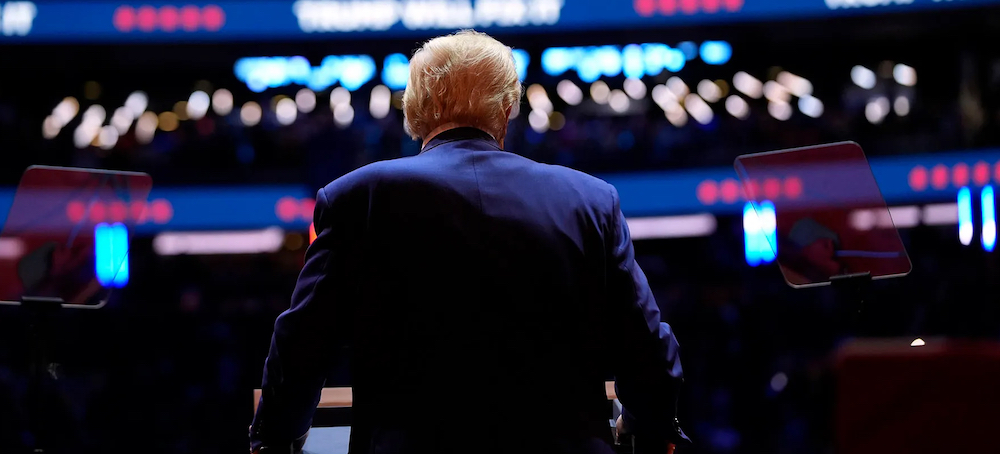 President Donald Trump. (photo: Alex Brandon/AP)
 An End to the War With Iran Was in Reach—and Trump Just Kept Sabotaging It
Fred Kaplan Slate
An end to the war was in reach—and Trump just kept sabotaging it.
President Donald Trump has thought that he can drag out the talks till Tehran bows to his demands because, in the 38 days of bombing that started in February, U.S. and Israeli air and naval power had wiped out so much of Iran’s military.
However, the Iranians think they control the game board because, despite the massive attacks, which hit more than 13,000 targets and killed the top echelon of Iran’s political leadership, the regime survived, the elite branch of its military remains in charge, enough missiles survived to threaten regional adversaries, and, through a shrewd strategy of asymmetric warfare, Iran continues to control and block the Strait of Hormuz, disrupting much of the global economy.
The war never had to happen, and it’s still unclear why Trump felt he had to start it. His initial rationale—to oust the oppressive regime so the Iranian people could take over—was always a pipe dream. (In private meetings, Trump’s advisers dismissed the regime-change scenario—which had been presented by Israeli Prime Minister Benjamin Netanyahu—as “bullshit.”) Not even Trump seems to have taken it seriously, since, as was later revealed, he and Netanyahu planned to install former President Mahmoud Ahmadinejad—one of Iran’s most oppressive leaders in recent years—as the ayatollah’s successor.
In recent weeks, Trump has said the war’s purpose was to eliminate—forever—Iran’s ability to build a nuclear weapon, though this too made little sense. Trump has often said that last June’s bombing raid, known as Midnight Hammer, “obliterated” Iran’s stockpile of highly enriched uranium. He has since qualified the claim, saying that as a result of the raid, the uranium, which was hidden inside a mountain, is now buried under a pile of granite so thick that Iranians can’t get at it—and if they tried, spy satellites would see them at work and we’d bomb the site again.
When Trump said that in a Fox News interview last month, the anchor asked him why we couldn’t just leave it at that and stop the war. Trump said in some ways it was enough, but not for “public relations.”
The elements of a diplomatic solution to the crisis were clear to anyone who had ever followed U.S.–Iranian affairs. Iran would have to reopen the Strait of Hormuz (reverting to the situation before the war started) and accept strict limits on enrichment and let international inspectors verify compliance (which it did under the 2015 Iran nuclear deal, signed by President Barack Obama and five other world leaders, a deal that Trump scuttled in 2018). The U.S. would have to end its naval blockade, sign some sort of nonaggression pledge, and unlock Iranian assets that had been frozen when Trump trashed the nuclear deal and reimposed economic sanctions.
Trump’s emissaries—his son-in-law Jared Kushner and his realtor friend Steve Witkoff—came close to piecing together such a deal through Pakistan emissaries. At one point, Iran agreed to export its highly enriched uranium and to suspend all enrichment for five years. Trump could have bragged that such a deal went further than Obama’s deal. But he countered that Iran needed to stop enriching for 20 years. While Iran was still mulling that idea, Trump publicly said that all the Arab and Muslim leaders in the region needed to sign the Abraham Accords and formally recognize Israel—adding that he hoped Iran would do so as well.
This ad hoc demand puzzled the Saudis and other rulers—who consider themselves allied with the U.S. and are hoping for an end to the war. It likely also made the Iranians wonder whether Trump really wanted to make a deal. Trump’s erraticism—his on-again, off-again threats to destroy Iran’s civilization, his announcements that a deal was pending within hours or days when in fact nothing had been agreed to—had already made them wonder whether he should be taken seriously at all.
Finally, the Iranians called the whole thing off. The final straw seems to have been Israel’s intensified bombing of Lebanon. The revival of that war was another product of the Trump-Netanyahu war on Iran. Last year, Israel had pummeled the Iran-backed Hezbollah militia, which had long controlled much of Lebanon; the Trump administration helped negotiate a ceasefire, which the Beirut government managed to enforce. However, when Trump and Netanyahu launched their air war on Iran in February, Hezbollah started firing missiles into northern Israel again. (This came as a surprise; most observers, including Israelis, had assumed that Hezbollah was all but decimated and its missile force obliterated.)
Throughout the U.S.–Iranian talks, Tehran’s delegates have insisted that the two wars involving Israel—in Iran and in Lebanon—were essentially the same conflict, and that a peace deal had to include a ceasefire in Lebanon. It has become clear in recent days that Netanyahu would not agree to stop bombing Lebanon as far as remnants of Hezbollah remained and that Trump would do nothing to make his Israeli friend change course.
What Trump will do now is unclear. It seems he doesn’t really want to resume bombing Iran. Certainly, the Iranians—who have watched him threaten to do so, then back off for no apparent reason, time and time again—have come to that conclusion. Trump thought the war would be over in days, maybe hours, just like the raid on Venezuela. Once the Iranians survived the onslaught, he has been boxed in—and has done nothing to climb out of the box, perhaps afraid that any sort of diplomatic deal would invite comparisons to Obama’s deal, which he has many times called the worst deal in history.
In the first hours after Iran’s withdrawal from the peace talks, Trump has reacted in two ways. First, in an interview with CNBC, he said, “I really don’t care, I couldn’t care less” if the talks were over, adding that the negotiations had “started to get very boring.” (The multinational talks that produced the 159-page Obama-era nuclear deal went on for 20 months.)
Then, in a social media post, he disputed the news reports, saying the talks with Iran were still going on and that Netanyahu had agreed to stop military action in Lebanon. Neither the Iranians nor the Israelis have confirmed Trump’s claims.
It is quite possible that Trump would like to forget about Iran—to back away from the war altogether. But that leaves open the fate of the Strait of Hormuz, which Iran isn’t going to open without some sort of deal—and the bombing raid’s devastation, if not repaired, will leave Iran in desperate conditions, which aren’t necessarily a prelude to peaceful behavior.
Trump had no clear vision going into the war, ignored his advisers’ warnings of the risks (including the possible shutdown of the Strait of Hormuz), contrived new rationales for the war that have no resonance with reality, and now is in denial over the multidimensional mess that he would like to leave behind.
It is with such acts of carelessness that leaders lose their credibility and empires lose their power.