
America’s Failing Gunboat Diplomacy
The Economist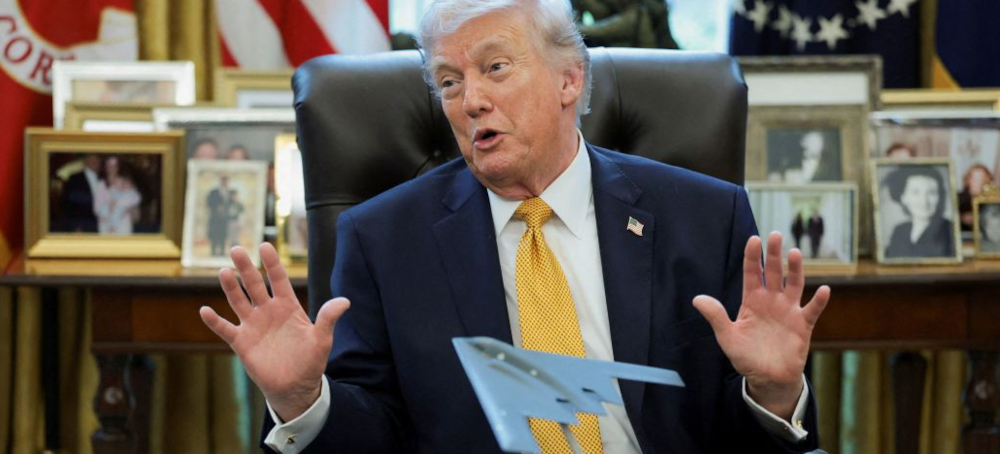 President Donald Trump speaks in the Oval Office on Monday. (photo: Jonathan Ernst/Reuters)
 America’s Failing Gunboat Diplomacy
The Economist
Like some fusty old imperialist, Donald Trump is flummoxed by foreigners
Sadly for Mr Trump, the world keeps startling him in return. Time and again threats and shows of force fail to work quite as expected, leaving his officials unable to hide their puzzlement. On February 19th, days before America and Israel pounded Iran, Fox News interviewed Steve Witkoff, Mr Trump’s all-purpose diplomatic fixer. Mr Witkoff, a garrulous sort, described his boss as “curious” that Iran’s leaders had not “capitulated”. Why, he mused aloud, had Iran not negotiated an end to its nuclear ambitions, given the American firepower amassed off its coasts?
After war began and Iran closed the Strait of Hormuz to most shipping, official Washington filled with claims that Mr Trump was surprised by this defiance, too. Pete Hegseth, Mr Trump’s secretary of war, testily denied that the administration had been taken unawares. He insisted that the Pentagon had plans to reopen this vital route. A few days after that, however, Mr Trump demanded that China and European allies help him open it up.
Iran is not the only example of Trumpian over-confidence. In January America’s special forces captured Venezuela’s dictator, Nicolás Maduro, and hauled him away for trial in New York. After that raid Mr Trump was able to pick a pliant new Venezuelan leader, Mr Maduro’s vice-president, Delcy Rodríguez. Mr Trump calls that a “perfect” outcome and wants to pick Iran’s new leader in the same manner. But the reality is that Mr Trump had initially miscalculated his leverage in Venezuela. Weeks earlier, the president’s chief of staff, Susie Wiles, explained the rationale for a campaign of American air strikes against boats accused of smuggling drugs from Venezuela. Mr Trump “wants to keep on blowing boats up until Maduro cries uncle”, she told a reporter. That was a bizarre misjudgment. A ruthless sort, Mr Maduro could not care less about alleged drug-runners being vaporised by American missiles. Hence the need for his spectacular capture.
Mr Trump is too sure that he can cow foreign leaders by threatening to bomb their countries. And he is overconfident that conflicts could be ended quickly, if only warring parties could understand that peace would bring an economic boom. In the words of his vice-president, J.D. Vance, Mr Trump does not understand why Russians and Ukrainians keep killing each other and do not “engage in some commerce with one another”.
Mr Trump has long struggled to understand people who believe in anything more than moneymaking, notoriously calling American soldiers “suckers” for dying in foreign wars. In his second term that obtuseness has been joined by a nostalgia for imperialism. A speech that Mr Trump delivered earlier this year is mostly remembered for blunt demands that Denmark sell him Greenland, its Arctic island possession. Fewer remarked on his tribute to colonialism as an institution. There is “nothing wrong” with acquiring territory, Mr Trump averred, sounding almost wistful about European empires that “had great, vast wealth, great, vast lands, all over the world” before going “in reverse”.
This was no one-off slip of the tongue. After Mr Maduro’s capture, Mr Trump boasted of outdoing his 19th-century predecessors in demonstrating “American dominance” over the western hemisphere. In February Marco Rubio, Mr Trump’s secretary of state, praised the missionaries and soldiers who set sail from Europe to build global empires, among them his own Italian and Spanish ancestors. Mr Rubio lamented that the decline and fall of those “great Western empires” was accelerated by “godless communist revolutions and by anti-colonial uprisings that would transform the world and drape the red hammer and sickle across vast swathes of the map”. Turning to the present, Mr Rubio rebuked Europe’s former imperial powers for admitting too many immigrants and for being “shackled by guilt and shame” about the past.
This is horribly selective history. The British, French and other empires did not vanish because Europe turned woke. Post-war Europe was broke and policing colonies was an increasingly costly and bloody business. Nor was Marxism the imperialists’ only foe. Many colonies were toppled by popular nationalism, the very same political force that Mr Trump urges every country to embrace. Moreover, nationalism was often stoked by aggressive colonial meddling, of the sort that Mr Trump relishes today. Just ask the British, who in 1942 made Egypt’s young king appoint a new government by surrounding his palace with tanks. Such humiliations radicalised a generation of nationalist army officers, who later pushed Britain out of Egypt and in time the Middle East.
When America stood for liberty
Most relevant of all, Europe’s empires crumbled under sustained pressure from America. For sure, American anti-colonialism included a hefty dose of hypocrisy. In 1953 the cia joined British spooks in organising a coup to overthrow Iran’s leader, Muhammad Mosaddegh, after he flirted with communism and nationalised British-controlled oil interests. Latin America saw cia-backed coups. But, as long as America was locked in a worldwide battle of influence with Soviet communism, successive presidents wished to be seen to be defending the rights of each and every people to govern themselves. America stood for freedom and progress, not with faded imperialist bullies.
Today, China is America’s worldwide rival and loves to talk of post-colonial solidarity with the global south. To Chinese leaders, Mr Trump’s global power-grabs are a propaganda gift. For now, alas, he seems too enraptured by gunboat diplomacy to care.