
America Last
Sarah Jones New York Magazine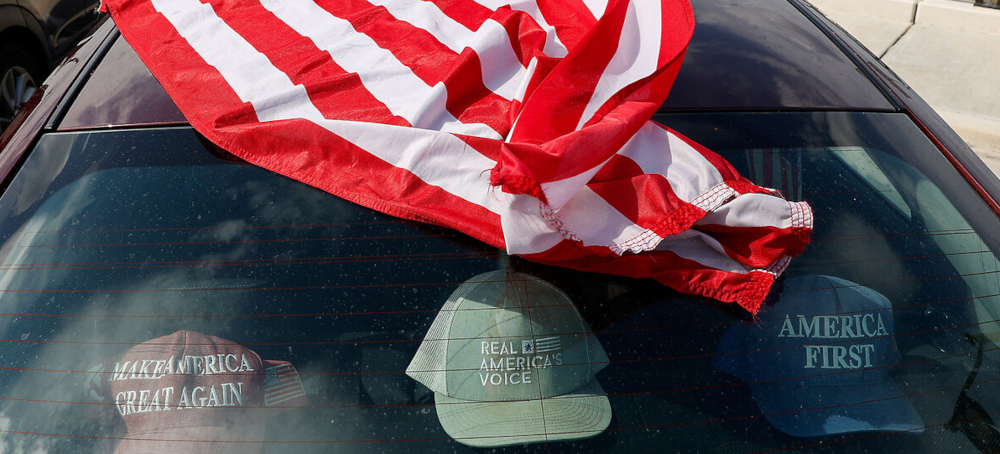 A car draped by an American flag and displaying hats in support of President Donald Trump is seen near the president's Mar-a-Lago estate in Palm Beach, Florida, Feb. 22, 2026. (photo: Marco Bello/Reuters)
 America Last
Sarah Jones New York MagazineThe administration believes, falsely, that white farmers face disproportionate rates of racially motivated violence in South Africa, citing high-profile incidents, such as murders and robberies. The lie began with the far right, where South Africa and Zimbabwe “have exerted a fascination” because they allegedly “show what happens to a white minority after they lose control of countries they once ruled,” The Guardian explained. Far-right Afrikaners speak to National Conservatism conferences and groups like the New York Young Republican Club to stir up support for their cause. Tucker Carlson, Ann Coulter, and Michael Savage have all joined in, eager to promote the idea of white genocide. They’ve found a willing mark in Trump, who said last year there’s “a genocide that’s taking place” that the media doesn’t “want to write about.”
This is, of course, not true. In 2025, Gareth Newham of the South Africa-based Institute for Security Studies told Politifact that the motive for most farm attacks appears to be robbery, not anti-white racism. A 2019 analysis by Carolyn Holmes of Mississippi State University found that, overall, farmers are far less likely to be the targets of violent crime than the general population. The South African author and filmmaker Richard Poplak had even blunter words about the white-genocide myth in a 2025 New York Times op-ed: “Indeed, South Africa helped define and perfect white supremacy, so take it from an expert: This is an effort to flip the narrative of apartheid, and cast former oppressors as victims,” he wrote.
The Trump administration’s sympathy for white Afrikaners is pivotal to a much broader betrayal of the American people. The Trump campaign promised voters in 2024 that he would be a president for them, unlike Kamala Harris, who would serve the shadowy other. Through mass deportations and industry deregulation, the new administration would usher in a era of prosperity. A year after Trump took office, however, the administration mostly caters to the whims of select, wealthy interests and prioritizes the appearance of strength on the international stage over sound economics, justice, or diplomacy at home. The U.S. war on Iran has cost $43.6 billion to date, the Pentagon said this month. Military operations in Venezuela, the Caribbean, and the east Pacific have cost “at least $4.7 billion from August 1, 2025—March 31, 2026,” according to a paper from Brown University researchers. The administration steals from taxpayers to enrich the powerful and commit probable war crimes abroad.
Meanwhile, the fabric of American public life unravels at a staggering pace. Although Treasury Secretary Scott Bessent claimed in August that our “K-shaped,” or unequal, economy “is over,” CBS News reports that wealth inequality has reached its widest gap in decades. Native-born unemployment has risen, according to one analysis by economist Mike Konczal. In fact, employment rates for native-born men, a fixation for J.D. Vance in particular, have fallen below 2024 rates, Konczal added. By the end of June, the Affordable Care Act’s marketplace enrolled nearly 3 million fewer people, the Center for Budget and Policy Priorities found. On Monday, Vance’s antifraud task force said it would un-enroll a further 760,000 accounts from the ACA’s public exchanges. Experts fear that legitimate enrollments may become “collateral damage,” as Cynthia Cox of KFF told The Wall Street Journal. The Department of Health and Human Services has cut grants addressing maternal mortality rates and health disparities in favor of “addressing the root causes of infertility,” including low sperm count, the Washington Sun reported this month. Trump and congressional Republicans have cut billions from SNAP with profound consequences for rural communities, where “a larger share” of residents “have low incomes and experience material hardship,” CBPP reported. Gas prices are rising and so is inflation. More renters are struggling to stay housed.
Now the public grows skeptical of Trump’s dedication to American greatness. An August poll from Politico found that half of all voters, and nearly a quarter of Trump’s 2024 supporters, “say the president’s mass deportation campaign is too aggressive.” The administration’s war with Iran is even more unpopular. Six months after the American military bombed an Iranian school and killed 123 children, 71 percent of Americans say they disapprove of Trump’s foreign policy and 26 percent approve of his handling of Iran, CNN reported. According to other news reports, Trump has approved a $2.8 billion sale of heavy bombs to Israel as it wages genocide in Gaza. The sale is morally abhorrent — and politically unwise, as slightly more Americans now sympathize with the Palestinians over Israelis in some polls. Among rural voters, who tend to favor Republican candidates, “frustrations about the cost of living” are beginning to eat away at enthusiasm for the GOP, a new KFF/AP survey says.
The American public was never a priority for MAGA. From the beginning, Trump promised spectacle; endless displays of nationalism punctuated by violence. Conservatives obsess over birth rates and trans kids because they are more concerned with a racial and gender hierarchy than wage growth or affordable health care. Afrikaners are learning this, too. Nearly 6,500 have already arrived in the U.S. under a special refugee program Trump created last year, but some are deciding to go home. Several told the right-wing Free Press they’d been “left to fend for themselves.” One couple said they eat one meal a day to preserve their resettlement funds, and no one took them to buy winter coats, though they’d been placed near Detroit. Other white Afrikaners reject the idea that they’re victims of anything like genocide, and few appear interested in applying for asylum in the U.S., which sets up a question: Who is this all for?