
A Quiet ICE Surge That Unfolded ‘Everywhere All at Once’ This Summer
Jazmine Ulloa, Miriam Jordan, Luis Ferré-Sadurní and David Ovalle The New York Times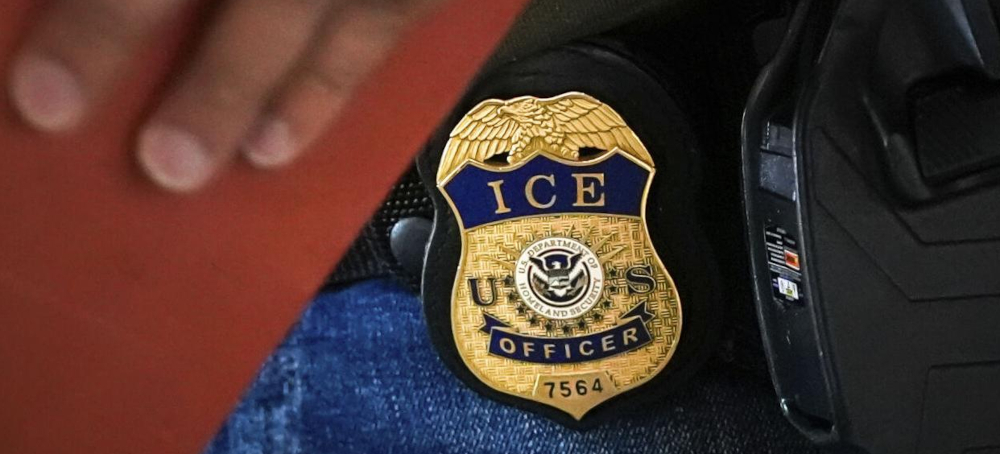 A review of dozens of incidents caught on camera sheds new light on a largely invisible crackdown. (photo: The New York Times)
 A Quiet ICE Surge That Unfolded ‘Everywhere All at Once’ This Summer
Jazmine Ulloa, Miriam Jordan, Luis Ferré-Sadurní and David Ovalle The New York TimesALSO SEE: ICE Ordered to Fix “Squalid” Conditions at NYC Detention Facility
A review of dozens of incidents caught on camera sheds new light on a largely invisible crackdown.
Unlike earlier high-profile raids that drew thousands of protesters into the streets of Chicago, Los Angeles and Minneapolis, the surge in arrests in June, July and August was captured mostly by grainy security camera footage, through cracked blinds and from behind closed doors.
Arrests by Immigration and Customs Enforcement this summer soared to record highs since the start of this Trump administration — with 43,000 in June, more than 49,000 in July and nearly 51,000 in August — as officials cut or narrowed the pathways to legal residency in the United States and expanded the pool of people eligible for deportation.
Federal agents appeared in nearly every corner of daily life, carrying out operations at hospitals and airports, outside suburban schools and along rural construction sites and truck stops. They fanned out from coastal cities in Maine to desert towns in Arizona, across the open plains of Wyoming and down through the southern borderlands.
In Republican-led states like Texas and Florida, where the swell was strongest, they amplified their reach through partnerships with sheriffs and state highway patrol officers. In Democratic strongholds, they intensified their activities despite laws meant to restrict them.
David Bier, director of immigration studies at the Cato Institute, a libertarian think tank, said the local partnerships, an infusion of federal dollars and new technology had made the dragnet so decentralized that it had attracted less attention.
“This gradual rise everywhere all at once, through a lot of means, is enabling the operation to fly under the radar,” he said.
The spike in arrests, to little public backlash, reflects a turning point in the Trump administration’s efforts to carry out large-scale expulsions of noncitizens. Those arrested were accused of violating civil immigration laws, but most had not been charged with or convicted of a crime. In a statement, ICE defended the expansion of immigration enforcement.
“This is promises made and promises kept in action,” the statement read. “The results speak for themselves.”
To understand how the operations have unfolded around the country, The New York Times reviewed arrest videos, photographs and court records from more than 50 incidents. What follows is a sampling of those interactions.
A Presence in Routine Places
Federal agents appeared as people carried out their everyday routines. People were detained en route to a soccer match. Leaving Sunday Mass. Having a drink at a nightclub. At national forests and outside polling locations.
Roger Hansen, 83, owner of the Little Big Load Laundromat in Madison, Wis., said federal immigration agents took five people from two of his locations in June. Statewide sweeps the same day resulted in the arrests of roughly 40 people, many of whom Department of Homeland Security officials said had criminal charges for sexual assault, driving while intoxicated and other crimes.
Security footage from one of Mr. Hansen’s laundromats shows two agents slamming a young customer to the ground near a soap dispenser. All the while, people continue to do laundry.
Outside, bystanders recorded the man being walked out in handcuffs and loaded into an S.U.V. with dark-tinted windows.
Mr. Hansen said he was disturbed by the violence. “They were having a heyday beating up on a kid,” he said, adding that business had dropped roughly 50 percent the next day and had not recovered. He said he believed many of his Latino and immigrant clientele may be too afraid to return.
In a statement, ICE said the arrests at the laundromat had been part of “targeted operations” in Wisconsin at the end of June. The five people from Nicaragua and Mexico were in the country illegally, ICE said. The agency did not respond to a question about their criminal records.
On July 7 in Salt Lake City, Elizabeth Garcia recorded three ICE agents forcing their way into her home without showing a warrant after following her father, Raul Moreno Meza, 52, from a gas station.
In the video, agents handcuff Mr. Moreno and his 15-year-old son, a U.S. citizen. Ms. Garcia howls and pleads as agents carry her father outside to their vehicles. Her 2-year-old can be heard crying in the background.
Before departing, an agent removed the shackles from Mr. Moreno’s son, who chased the S.U.V.s as they drove away. Mr. Moreno was later released on a bond, his daughter said, but her brother has become withdrawn and is attending therapy.
“He had lots of goals and intentions,” she said. “Now he is so negative.”
In a statement, ICE said officers arrested Mr. Moreno after he did not yield to officers at a traffic stop and then fled on foot. The agency alleged in the statement that “a juvenile occupant of Moreno’s vehicle” had assaulted an officer and was “detained in handcuffs for safety.”
Mr. Moreno, an undocumented Mexican man, crossed the border unlawfully about two decades ago, after his green card petition languished in delays and as his father, a naturalized U.S. citizen, fell ill, his family said. His father later died. Because Mr. Moreno’s green card petition was tied to his father’s citizenship, the application did not advance after the death, the family said.
All Corners of the Country
Immigration arrests climbed to near record highs in almost every state. Some of the sharpest percentage increases in daily arrests occurred in Oregon, Montana, Hawaii, New Mexico, Vermont and New Jersey.
In June, the dragnet came to Harrison, N.J., where Asian and Hispanic residents account for about 65 percent of the population.
Tugrul Ozkarsli, 33, of Turkey, had just pulled up to his home with groceries when ICE agents in plain clothes boxed his vehicle in with their S.U.V.s, his wife, Kendra Ozkarsli, 46, said. He honked his horn and called her from his phone.
“All I hear is him screaming,” Ms. Ozkarsli recalled. She ran downstairs to find agents pulling him out of the vehicle.
“I’m married!” Mr. Ozkarsli yelled as agents handcuffed him.
“What are you doing? What are you doing?” Ms. Ozkarsli repeated, her hands shaking as she recorded with her phone. “This is my husband! Please stop!”
Mr. Ozkarsli had entered the United States legally on a business visa in December 2024. Before it expired, he applied for a student visa, which is still pending, Ms. Ozkarsli said. ICE said the pending application did not give him legal status.
The agency also said he had been arrested on burglary charges in New York last year. Ms. Ozkarsli said he was arrested after he entered the apartment of a woman he was dating at the time to retrieve his wallet and passport, prompting the woman to call the police. The charges were ultimately sealed and dismissed, she said.
Mr. Ozkarsli and Ms. Ozkarsli had married this summer, and he had been preparing to apply for a green card, she said.
From Roads to Airports
Traffic stops were central to the summer surge. Some were deadly. In Houston and Biddeford, Maine, traffic stops ended in fatal shootings involving officers. An encounter between people in a vehicle and agents at a Florida gas station resulted in a fatal car crash.
In Milwaukee, Frankely Quezada, 34, and Estenderly Marte Polanco, 31, of the Dominican Republic, were running errands with their 7-year-old son on a Saturday morning in June. Near home, Mr. Quezada said, he noticed an unmarked S.U.V. trailing his van. He turned into an alley and accelerated.
The vehicle behind him flashed its lights, and as Mr. Quezada crossed the street, more S.U.V.s emerged to box him in. Federal agents jumped out, and one of them pointed a yellow stun gun at him and shattered his window, Mr. Quezada recalled. From a balcony, a neighbor filmed officers dragging Ms. Polanco out as her son cried.
Mr. Quezada, who was not arrested, said Ms. Polanco bit a federal agent as they drove her away after he shoved her face into her lap so forcefully she believed she would suffocate. Ms. Polanco, who overstayed a visa and has no other criminal record, remains held without bond in Kansas.
In response to questions about Ms. Polanco’s arrest, ICE said in a statement that both Mr. Quezada and Ms. Polanco had been combative and refused to obey commands and that Ms. Polanco would remain in custody as her case moves through immigration proceedings.
ICE also stepped up its arrests of foreign citizens at airports in July, in encounters that could be more surreptitious. Footage recorded by an airline manager on July 13 captured two ICE officers in plain clothes approaching a gate agent at Dallas Fort Worth International Airport before a flight to Portland, Ore. They identified themselves only as federal officers and instructed the employee to page a passenger.
Flanking the woman, the men discreetly took her into custody, according to the manager, who asked not to be identified, citing concerns for her job. The worker followed them, recording as they escorted the passenger through the concourse, one of them wheeling her luggage.
In the parking lot, the woman was handcuffed and put into an unmarked vehicle.
ICE agents told the manager that the woman was being detained because she had overstayed her visa. U.S. authorities did not share her name with The Times or provide information about her whereabouts.
No More Protected Areas
During the summer surge, displays of force were routine inside some courthouses, and federal agents have increasingly been spotted at and near hospitals and schools.
ICE acknowledged operating in courthouses but said officers did not target schools.
“Nothing in the Constitution prohibits arresting a lawbreaker where you find them,” the agency said in a statement. “The ability of law enforcement to make arrests of criminal illegal aliens in courthouses is common sense. It conserves valuable law enforcement resources because they already know where a target will be.”
On the morning of Aug. 20, Grace Calero, 39, and her daughter, Giulianna Carriel, 19, were rushed to a hospital after a car crash south of Orlando, Fla. As medical staff treated them for injuries, a federal agent entered the emergency ward and began questioning Grace’s sister, Gia Calero, about the women’s immigration status, the sister said.
He remained in the room, joking with nurses.
It wasn’t until hours later, after Grace’s neck brace was removed, that the officer announced he was with ICE, Gia said. In the dramatic scene, captured by Gia on her cellphone, five deputies with the Polk County Sheriff’s Office arrived. They handcuffed Grace as Giulianna wailed on a bed, clinging to her mother and begging them not to take her.
“They didn’t even let them recover,” Gia Calero said.
In statements, ICE and Polk County sheriff’s officials said the women had overstayed their visas. Gia said her sister and niece had pending asylum claims, stemming from attempted kidnappings in Ecuador. The two have since been deported to their native country.