
A Most Trumpian Plan to Make Nice With Russia
Simon Shuster The Atlantic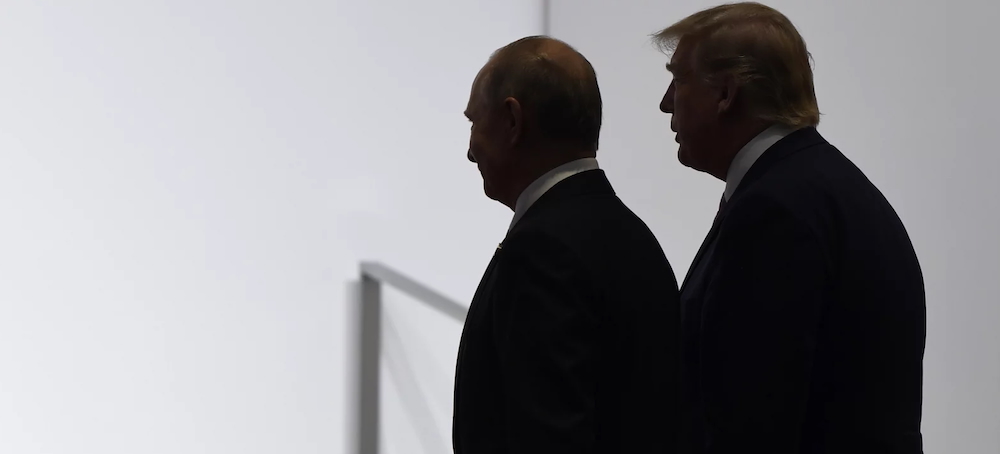 President Donald Trump and Russian President Vladimir Putin walk together. (photo: Susan Walsh/AP)
 A Most Trumpian Plan to Make Nice With Russia
Simon Shuster The Atlantic
Trump’s envoy wants to trade Russian political prisoners for U.S. sanctions relief, creating a path to business deals before the war in Ukraine ends.
This new initiative, which is still in its early stages and has not been previously reported, promises to advance several of Trump’s goals at once. It would help reintegrate Russia into the global economy and broaden Trump’s talks with the Kremlin beyond the intractable war in Ukraine, which his envoys have failed to end after more than a year of diplomacy. It would create a path for the U.S. to sign lucrative deals involving Russian oil, diesel, rare earth minerals, and other commodities. As a bonus, the release of prisoners on humanitarian grounds could bolster Trump’s case for his long-coveted Nobel Peace Prize.
This fresh approach to dealing with the Kremlin, however, is likely to outrage the Ukrainians, the Europeans, and even many of Trump’s allies on Capitol Hill. Any potential business deal between the U.S. and Russia would risk funneling money to the Russian military even as it continues to terrorize Ukraine and threatens a wider war against U.S. allies in Europe.
Earlier this month, Trump signed a law co-authored by Lindsey Graham, the late Republican senator, authorizing Trump to impose severe sanctions on Russia and its trading partners. Even against that backdrop, Trump’s diplomatic envoys have been quietly looking for ways to ease U.S. sanctions and do business with Moscow.
John Coale, the envoy who proposed the new strategy involving the release of political prisoners, has spent more than a year testing it in Belarus, Russia’s closest ally. In talks with that country’s dictator, Alexander Lukashenko, Coale won the release of hundreds of prisoners from Belarusian jails. In exchange, the U.S. has eased its sanctions on Lukashenko’s regime and pursued a deal to buy his country’s most valuable export, a type of fertilizer known as potash. With Trump’s blessing, Coale has now set out to try the same trick with Vladimir Putin in Russia.
Last week, Trump announced that the U.S. is negotiating a “massive” potash deal with Belarus. Coale, a former lawyer to Trump, told me that Russia is also a part of those negotiations. Since the start of the war in Ukraine, the U.S. has avoided trade deals involving Russia. This one would mark a rare exception if finalized. In Coale’s view, it would also help advance the cause of peace.
“All this stuff works toward the possibility of peace,” Coale told me. “The more interaction, the more trade-offs—either economic, prisoners, or whatever—leads step by step toward, hopefully, peace. That’s kind of the mission.”
The Ukrainians see it differently. Belarus has served as a Russian staging ground for the invasion of Ukraine, and Lukashenko has provided the Russian military with bases, supplies, and ammunition. During his visit to New York last week, Ukrainian President Volodymyr Zelensky told me he would try his best to “block” any attempt to lift the sanctions on Russia before the war ends. “But it’s difficult,” he conceded. The Russian economy is roughly 10 times larger than Ukraine’s. “It’s very difficult to compare with Russian money, with their business.”
Ever since putin first sent troops into Ukraine, in 2014, the U.S. and Europe have used just about every variety of sanction to punish Russia for its attacks, targeting Moscow’s political elites, its industrial base, its banking system, its energy sector, and other sources of money and technology that Putin needs to wage the war. Trump temporarily eased some of those sanctions this spring, when he allowed Russia to sell more fuel on the global market, hoping to alleviate the oil-price shock caused by the U.S.-Israeli war with Iran.
Ukraine denounced that decision at the time. In his speech last week to the United Nations General Assembly, Zelensky again urged the West to intensify and enforce its sanctions on Russia, including the new measures Trump signed into law this month. “When someone gives Russia more money through trade, they give this war more time,” he said. In reference to Putin, he added: “Limit his money. Limit his war.”
But the American negotiators have taken a softer approach, seeking to pacify Putin with the promise of economic growth. After his visit to the Kremlin earlier this month, Trump’s son-in-law Jared Kushner described the money to be made on the back of a peace deal. He told the audience at a conference in Kyiv that business deals—or, as he called them, “prosperity agreements”—form an essential part of Trump’s strategy. If they agree to a cease-fire, Putin and Zelensky “need to have something to look forward to” in terms of foreign investment and higher living standards for their citizens. “I think that’s what gets the societies invested and excited about peace,” Kushner said via video link at the Yalta European Strategy conference. “Also it becomes, in some ways, your best security guarantee.”
Ukrainians, of course, have plenty of reasons to be excited about peace apart from the prospect of higher wages. The casualty count in this war has topped 2 million people, killed and wounded, on both sides, and Russia continues to bombard Ukrainian cities day and night. Ukraine has responded with a campaign of strikes against various targets in Russia, particularly its oil refineries and other energy infrastructure. As part of any peace deal, Zelensky has demanded ironclad security guarantees from his Western allies to ensure that Russia does not attack again in the future. His negotiators told me that they do not see “prosperity agreements” with Russia as any kind of security guarantee for Ukraine. Quite the opposite: They see Western trade with Russia as a way for Putin to strengthen his military and continue the war.
In recent weeks, Ukrainians have been dismayed to hear Trump’s envoys use peace negotiations as a means of advancing business deals. “This is the thing that drives them now,” one of the negotiators told me of the Americans. A second negotiator added: “They believe in the magic of business. They think that if they make these business deals, the Russians will not lapse back into militarism” after the war.
As of now, the second negotiator added, Trump’s envoys do not see a way to do business with Russia without first achieving at least a partial cease-fire in Ukraine. But Coale’s strategy offers a possible work-around. The release of Russian political prisoners could give the U.S. a reason to ease sanctions, creating space for the financial transactions that Trump would like to pursue with the Russians. In Coale’s view, such deals could help bring the Ukraine war closer to a cease-fire by easing tensions between Russia and the West. “Economic ties usually result in normality,” he told me.
Coale’s proposal emerged from a meeting he had this spring with a Russian dissident, Dmitry Muratov, who was awarded the Nobel Peace Prize in 2021 for his decades of journalism and human-rights activism. The newspaper that Muratov co-founded and edited for many years, Novaya Gazeta, was forced to shut down soon after Putin launched the invasion of Ukraine, in 2022. Since then, Muratov has devoted most of his time to speaking out against the war and trying to free the Russian activists imprisoned for opposing it.
Over the past year, he has closely followed reports of Coale’s work in Belarus, which I have written about at length. Coale and other U.S. diplomats have secured the release of about 500 political prisoners in Belarus, including a few American citizens. At the end of last year, Muratov asked me for an introduction to Coale. The dissident wanted to see whether Trump’s envoy could make the same appeals to the Kremlin as he had in Minsk. The release of prisoners, Muratov argued, has long been a part of American diplomacy in Moscow. At summits with Mikhail Gorbachev, the last leader of the Soviet Union, President Ronald Reagan or his envoys would often present the Soviets with lists of imprisoned dissidents and ask for their release. Gorbachev routinely obliged, creating a humanitarian dimension to his broader efforts to ease tensions with the Americans and reduce the risk of nuclear war.
After the collapse of the Soviet Union, in 1991, Gorbachev and Muratov co-founded Novaya Gazeta and, over the years, it became Russia’s leading source of investigative reporting about the Kremlin’s abuses of power. Several of its journalists, including the legendary war reporter Anna Politkovskaya, have been murdered for their work.
Before his death, in August 2022, at the age of 91, Gorbachev gave Muratov some of his possessions as keepsakes, including a commemorative medallion that Reagan gave to the Soviet leader at one of their summits. In May, Muratov brought the medallion to Washington and presented it to Coale as a token of admiration for his efforts in Belarus. Over plates of sushi at Ned’s Club, a members’ club popular among the political cognoscente, he told Trump’s envoy about the history of prisoner releases during the Cold War and the urgent need to revive this practice between the U.S. and Russia.
Muratov brought photos of several of the dissidents whom Russia had jailed for their opposition to the war, and he told Coale their stories. He brought up the poet and theater director Evgenia Berkovich, who had picketed against the war in 2022. A Russian military court later sentenced her and her friend, the playwright Svetlana Petriychuk, to six years in prison on terrorism charges, part of a Kremlin campaign to criminalize any opposition to the war. Hundreds of people have been jailed in Russia for such offenses, some given years of incarceration for deeds as trivial as questioning the war in a comment on social media.
Coale, for his part, described to Muratov the joy he felt the first time he managed to free a group of prisoners in Belarus last year. The experience gave the lawyer a new sense of purpose, he said, and he agreed to try a similar approach with the Russians. Soon after the meeting, Coale raised the idea with Trump, who gave his consent to try it, Coale told me.
Yesterday, the White House nominated Coale to serve as the special presidential envoy for hostage affairs, with the rank of ambassador, a role that will require Senate confirmation. Asked to comment on his mission, a White House official said: “The President and his team remain committed to continuing to play a constructive role in ending the war between Russia and Ukraine, and he remains optimistic that we’ll ultimately get a peace deal done.”
Coale plans to coordinate his efforts with Steve Witkoff, who serves as Trump’s main point of contact with the Russians. A billionaire real-estate developer with no formal diplomatic experience, Witkoff has met with Putin at least seven times since the start of the war in Ukraine. During his most recent visit to the Kremlin, on September 5, the Russian leader expressed his gratitude to Witkoff and Kushner for their attempts to negotiate a peace deal. “I’d like to tell you that we find it comfortable to work with you, and, of course, we have a very high level of trust during this work,” Putin told the two Americans, according to footage of the meeting published on the Kremlin website.
In response, Witkoff thanked Putin for releasing an American teacher, Bob Gilman, who had been jailed in Russia since 2022. Their conversation then shifted to the war in Ukraine. Kushner and Witkoff planned to fly from Moscow to Kyiv via Poland the next day, according to two people familiar with their travel arrangements. Neither of the American envoys had visited Ukraine during the war. As part of their preparations, Putin said, the Americans had requested a three-day cease-fire to allow the trip to proceed safely, and the Russians had given their consent. “I issued the respective order,” Putin said, adding that, since midnight that day, no strikes had been carried out on Kyiv.
This appears to have been a lie. That morning, a Russian drone struck the territory of Kyiv’s main airport, in the city of Boryspil, where Witkoff and Kushner had been due to land the following day, according to the two people familiar with their travel plans. One of them, a Ukrainian official, showed me surveillance footage of the strike and photos of the crater it left near the runway. After the attack—which took place at 9:12 a.m. on September 5, while Kushner and Witkoff were flying to Moscow—the Americans changed their plans for the next day and traveled to Kyiv from Poland by train, the two people familiar with their trip told me.
(The drone strike on Boryspil and its consequences have not been previously reported. A U.S. official familiar with the trip denied that Kushner and Witkoff changed their plans because of the airport attack but said that, in general, their travel arrangements often shift on short notice.)
When informed of their need to reach Kyiv by train, the Ukrainian railway company scrambled to prepare a luxury cabin for the U.S. delegation, complete with a spread of Tatar cuisine from Crimea and a little sign on the dining table that said peace arrives on time.
After arriving in kyiv, Kushner and Witkoff met for several hours with Zelensky and his team of negotiators. Two of them later told me that the talks focused on a variety of ways to achieve a limited cease-fire, which could be expanded into a broader peace deal to end the war in stages. “Their whole message right now is to shrink the conflict, in any way, from any direction,” one of the negotiators said of the Americans.
Next month, he said, they aim to organize a gathering of envoys from the U.S., Russia, and Ukraine, most likely in Abu Dhabi, to discuss a limited cease-fire. It could oblige each side not to strike the other’s energy infrastructure, including power plants, oil refineries, and similar targets. A separate deal, mediated with help from the government of Egypt, would call for Russia and Ukraine not to strike one another’s cargo ships in the Black Sea, particularly those carrying grain to markets in the Middle East and Africa, the negotiators told me.
The Americans have been keen to arrange a meeting with Trump, Putin, and Zelensky as soon as possible. On Wednesday, Secretary of State Marco Rubio announced that the U.S. had invited Putin to the G20 summit to be held in December, at Trump’s golf club in Miami, where Trump could also try to bring Zelensky to the table. Putin has yet to accept the invitation.
Regardless of the venue and format, Zelensky would be eager to participate in such a summit, one of his close aides told me: “He still has this idea that he can look Putin in the eyes and figure this out.” Putin has shown no such inclination. Although he seemed happy to host Kushner and Witkoff at the Kremlin this month, Russian attacks on Kyiv and other cities have grown deadlier and more frequent in recent weeks. For the first time since the start of the war, Russia has begun launching regular daytime strikes against the Ukrainian capital, killing or wounding scores of civilians, forcing businesses to close and schools to hold classes in bomb shelters.
Two days before Kushner and Witkoff arrived in Kyiv, a Russian drone slammed into the headquarters of Ukraine’s main intelligence agency and exploded inside the office of its director. He survived the strike, but the Ukrainians saw it as a major escalation and a sign of Russia’s plans for the next few months. None of the handful of officials in Zelensky’s administration who spoke with me for this article expected Putin to engage in any serious peace talks until the spring at the earliest. “He has been stockpiling missiles for a reason, and he intends to use them this winter,” one of them told me.
Given that lack of will on the Russian side, the flurry of peace talks initiated by Trump’s envoys in recent weeks has felt like a waste of time to some of the participants. As one of them described it to me the other day, “It almost feels like we’re all just dancing around Putin, offering him this and that, whatever we can think of, but he’s not moving.”
Coale’s plan would seek to break that impasse. The issue of political prisoners, once introduced into the dialogue between the U.S. and Russia, would give Putin an easy way to demonstrate goodwill and create fresh signs of diplomatic progress with the Americans while continuing to terrorize Ukraine. Last month’s release of Gilman, the American teacher, serves as a case in point, and Coale told me that he has already gathered a list of other Americans held in Russian prisons. A separate list, compiled with help from Muratov, will include dissidents, journalists, and others incarcerated for their opposition to the war.
Trade and business talks would run parallel to these discussions, and one business deal has already demonstrated how they could work, expanding the points of contact between the U.S. and Russia beyond the peace talks in Ukraine, Coale told me. Last Tuesday, Trump announced on Truth Social that the U.S. was working on “a massive Deal with respect to the purchase of Potash from Belarus,” adding that it would be “very good news for our Farmers and Ranchers.”
That deal resulted in large part from Coale’s work. In response to the release of political prisoners, the U.S. lifted some of its sanctions on that country’s regime to allow the deal to proceed. The discussions also involve Russia, Coale explained. European countries have not agreed to ease their own sanctions on Belarus, and they have refused to allow the transport of potash from Belarus across their territory. That means it would most likely need to move eastward through Russia before reaching international markets, making the Kremlin a party to the deal.
“If the West is buying potash, then they’ve got to deal with the Russians and the Belarusians. So you’re sitting down at a table, and you’re haggling over price or finding the routes to get it out,” Coale told me. “When people talk, it’s a good thing. Even if they’re talking about potash, it may go into having the countries, as I say, going back to the family of nations with the rest of the world.” Coale said his strategy would not abandon Ukraine, but it would seek to strengthen ties between the U.S. and Russia, encouraging Putin to end the war as part of a broader agenda of business and trade with the West. By switching from the stick of sanctions to the carrot of mutual profits, this plan follows a lesson Coale learned last year from Putin’s closest ally, the Belarusian dictator Lukashenko. “In the name of peace, maybe you’ve got to be a little cunning and make some concessions,” Lukashenko told me last August, describing the advice he gave Coale for dealing with the Kremlin. “Even if you can’t make sense of Putin, treat him like a human being.”
As the U.S. began easing sanctions on Belarus last year, Lukashenko helped the Americans arrange a summit with Putin in Anchorage, Alaska, where Trump greeted the Russian leader on a red carpet. Their talks did not result in any breakthrough in the efforts to end the war in Ukraine. On the contrary, Russia only intensified its attacks on Ukraine’s power plants, apartment blocks, and other civilian targets. But the Alaska summit did ease the diplomatic isolation of Ukraine’s main adversaries. On his flight to Anchorage aboard Air Force One, Trump called Lukashenko to thank him for releasing political prisoners and, in a post on social media, referred to the despot as a “Highly Respected President.”
Ever since, Coale has continued working with Lukashenko to win the release of prisoners and negotiate business deals. His approach has alarmed many diplomats in Europe, who have called on the U.S. to maintain its sanctions pressure on Belarus and Russia. The leader of the democratic opposition in Belarus, Svetlana Tikhanovskaya, told me last week that the exchange of prisoners for sanctions relief will only encourage the regimes in Russia and Belarus to take more prisoners. “This trade in human beings costs them nothing,” she said during her visit to New York for the UN General Assembly. “They can always arrest more people, while the West loses its leverage over these regimes by lifting sanctions and making deals.”
Tikhanovskaya’s own husband, a prominent blogger in Belarus who tried to run for president against the country’s dictator in 2020, was freed from prison last year in a release that Coale negotiated with the regime. When I pointed out the contradiction in Tikhanovskaya’s stance, she struggled for a moment to explain it. Her family, which now lives in exile, had been reunited thanks to the Trump administration’s strategy of swapping economic deals for foreign detainees. Yet she now argues that the families of other political prisoners should not benefit from such trades. “I know it seems unfair,” she said finally. “But if we do this, in Russia or in Belarus, those regimes will take more hostages, and their families will go through the same horrors that we did.”
Muratov’s stance on this dilemma bears an even greater irony. He lives in Moscow, and the prominence bestowed on him by the Nobel Peace Prize would make him a valuable prisoner for the Kremlin to trade away. Russian authorities recently began investigating his taxes, which could give the Kremlin an easy excuse to put Muratov in jail and offer him up to the Americans in exchange for sanctions relief. But the dissident does not seem deterred by that risk. If Coale’s campaign frees the innocent people already jailed in Russia for speaking out against the war, Muratov told me, it will have been worth it for them and their families, even if the story ends with him in a prison cell.