
A Hundred Saddams Now
Bobby Ghosh Ghoshworld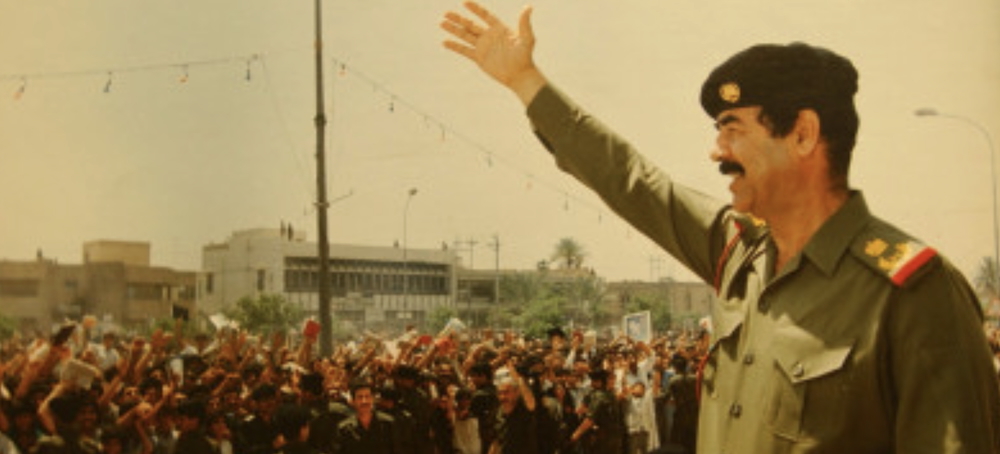 Saddam Hussein. (photo: Getty Images)
 A Hundred Saddams Now
Bobby Ghosh Ghoshworld
Iraq’s founders set out to make the old authoritarianism impossible. A new handbook explains what they were up against.
As a correspondent in Iraq from late 2002 to the end of 2007, I had variations of that conversation with many of the emerging political class. Exiles back from London and Tehran, clerics, former generals, men who had done time in Abu Ghraib when Saddam Hussein ran it — they all told me the same thing. They were writing laws and building institutions so that the old system could never be reassembled. No more secret police, no more one-party rule, no more authoritarianism.
Some of them even meant it.
Fanar Haddad’s chapter in the new I.B. Tauris Handbook of Authoritarianism in the Arab Worldexplains what became of that project. Haddad, who now teaches at the University of Copenhagen, was a senior advisor on international affairs to the Iraqi prime minister, so he has watched the system work from the inside. He rejects both of the stories Iraqis now tell about themselves: Iraq, he argues, is neither the democracy Allawi and company promised nor Saddam’s weaponized state with the serial numbers filed off.
Haddad describes something else: a state in which power has been broken into so many pieces that a great many people can now do to a citizen what one tyrant used to. He calls this decentralized authoritarianism. Elections are real and held on schedule, but so are the assassinations. The 1969 penal code — the one Allawi claimed he wanted gone — is still in force. Article 229 of that code criminalizes insulting a state official. Recent governments have used it more than their predecessors.
Much of the punishing has no legal form at all. A man is filmed insulting a party or a tribe, and a second video appears of him being beaten, or having his head shaved, or reading an apology into a camera. Someone who has crossed the Sadrists, Haddad writes, does better appealing to Muqtada al-Sadr for clemency than to the state for protection. Haddad quotes the line you hear in Baghdad now: We used to have one Saddam; now we have a hundred.
Haddad’s is one of 28 chapters of the handbook, edited by Dana El Kurd, an associate professor of political science at the University of Richmond and a senior nonresident fellow at the Arab Center Washington. It is the most useful single volume on the subject to appear since the Arab Spring.
For thirty years the field of Middle East studies has asked why Arab autocracies survive. El Kurd asks how authoritarianism gets produced, financed, exported, justified and resisted, and that question covers a wider landscape. Rulers and security services are here, and so are social media companies, sovereign wealth funds, renewable-energy financiers, migration deals, tax collectors, the informal economy, and Syrians and Ukrainians who found each other over a shared enemy.
El Kurd takes her framework from Marlies Glasius, who argued in International Affairs in 2018 that scholars should study authoritarian practices instead of authoritarian regimes. Glasius defines those practices as “patterns of action that sabotage accountability,” and notes that democracies produce them too.
El Kurd also wanted the book to see the region from its edges; repression usually shows up at the margin first. Joanna Allan writes on Western Sahara, where Moroccan officials talk about women’s rights while the women who protest are beaten in the street and punished in prison. Allan calls the technique was it is: genderwashing.
Palestine runs through the whole book. Abdulla Moaswes and Meriem Naïli set Morocco and Israel side by side and argue that both run on settler-colonial logic. Alexei Abrahams and Haaya Naushan write about the visual record of the war in Gaza, created by Palestinian journalists and amateurs, sometimes at the cost of their lives. That record now lives on commercial servers in California under dubious content policies; Abrahams and Naushan describe how researchers have started scraping the evidence before moderators remove it.
El Kurd began commissioning in the summer of 2023, and two interesting chapters were overtaken by events during the writing. Ammar Shamaileh of the Doha Institute for Graduate Studies studies nondemocratic ruling networks and the political economy of Syria. His opening chapter asks how such a network survives a change of leader and takes Syria as its case. He was still working on it in December 2024, when the network collapsed.
Yassin al-Haj Saleh wrote his from Istanbul, where he had lived since 2013, the year the Islamist group Jaysh al-Islam seized his wife, the activist Samira al-Khalil, in Douma. She has not been seen since. His chapter takes apart the machine that took her: a visible state of ministries and parliament with authority over nothing, and behind it the family and the security branches. By the time the book was printed that machine was gone.
In her introduction El Kurd accounts for who is missing from the book. Contributors were driven into exile while it was being assembled. Others withdrew as things worsened at home. There were institutions she could not approach at all, because in some countries an invitation to write about authoritarianism is grounds for arrest. Readers who notice omissions, she writes, “should bear the political context in mind.”
El Kurd devotes a full section to resistance, and the theme runs through the rest of the book. Yasmeen Mekawy writes on emotion in the Egyptian uprising, setting the middle-class internet activists against the soccer ultras, who came to Tahrir Square with years of practice at fighting riot police in stadiums. Amir Abdul Reda and Youssef Assarssah run two decades of protest data and conclude that the Arab Spring opened a new cycle of contention.
Taken together, the chapters argue that Arab authoritarianism can no longer be explained by rulers, oil, Islam or weak institutions. It is networked and internationalized, financed through global markets, ideologically flexible, mediated by companies headquartered in Menlo Park, and tangled up with colonial structures the field never used to count. Authoritarianism has adapted since 2011, and the closing chapters argue that the people living under it have adapted just as fast.
Twenty-two years ago the Iraqi politicians I interviewed believed that a well-written constitution would keep the old system out. They got their constitution, but no document could write out the hundred Saddams. Handbooks are made for graduate students, but this one belongs with the people who still think institutions are enough on their own.