
A Deep Freeze in Kyiv
Michael Holtz The New Yorker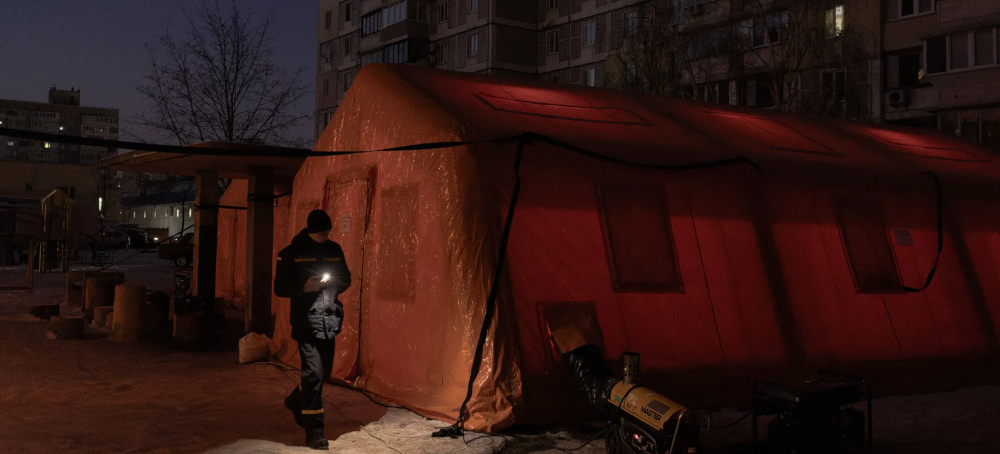 Russia has weaponized the most frigid winter in more than a decade. (photo: Roman Pilipey/The New Yorker)
 A Deep Freeze in Kyiv
Michael Holtz The New Yorker
How Russia has weaponized the most frigid winter in more than a decade.
The plant that Orest helps run is owned and operated by DTEK, the largest private energy company in Ukraine. Officials at the company, citing national-security concerns, asked me not to go into detail about the damage caused by the attack. (They also asked me not to disclose the plant’s exact location or the last names of employees.) What I can say is that, on a recent afternoon, as I walked around the second floor of the plant’s cavernous turbine hall with Orest and my interpreter, Yuliia Vallenfanh, I was struck by how quiet and cold it was. “If the generators were running, we wouldn’t be able to talk like this here,” Orest said. We were standing beside a fifteen-foot-tall turbine, our breath visible in the air. Orest, who has worked at the plant for almost twenty-eight years, said that the stillness got to him most during his night shifts. “I know what’s supposed to be running—what should be humming, what should be spinning,” he said. “The silence puts you on edge.”
The cold did, too. “Right now,” Orest continued, “the temperature inside the plant is basically the same as the temperature outside,” which, on that particular day, was below thirty degrees Fahrenheit. Orest explained that the freezing weather made repairing damaged equipment all the more difficult and time-consuming. “Everything is covered in ice,” he said. Nearby, a mechanic named Andriy was using a propane torch to defrost the bolts on a steel valve that connected the plant’s boilers to its turbines. “I think I’ll have it open by the end of the day,” he said. It was only noon. Fifty feet below, on the ground floor of the hall, one of his co-workers added scraps of wood to fires that had been lit in three rusted oil drums. Aside from Andriy’s torch, they were the only sources of heat that I saw in the entire plant.
This winter has been, according to some reports, the coldest in Ukraine in more than a decade. It’s certainly the coldest since Russia began its full-scale invasion of the country, in February of 2022. In Lviv, where I live, temperatures have regularly dipped into the single digits. The same is true for much of the country. Seizing on the frigid weather, Russia has launched an all-out assault on Ukraine’s energy infrastructure, with the apparent aim of keeping up pressure amid ongoing peace negotiations—and sapping public morale. “Millions across Ukraine are living through an emergency, freezing in apartments that sometimes have no heating, water, or electricity,” Maxim Timchenko, the C.E.O. of DTEK, told me, in a written statement. In large cities, such as Kyiv, the capital, he warned of a potential “humanitarian crisis.”
The bombardment has been relentless. From the beginning of October through the middle of January, Ukraine’s intelligence service documented two hundred and fifty-six drone and missile strikes on energy facilities: eleven on hydroelectric power plants, ninety-four on thermal power plants, and a hundred and fifty-one on substations. “There is not a single power plant in Ukraine that the enemy has not attacked,” the country’s energy minister, Denys Shmyhal, told lawmakers in Kyiv on January 16th. “Thousands of megawatts of generation have been knocked out.” In a sign of how dire the situation has become, Shmyhal called on businesses to turn off their outdoor advertising. “If you have excess electricity, give it to people,” he said.
At the power plant I visited, repair crews were working twenty-four hours a day to get whatever they could back up and running. There was only so much they could do. With stocks of spare parts running low domestically, Orest said that former Eastern Bloc countries, such as the Czech Republic and Bulgaria, were the most obvious places to turn for help. “Many of their power plants are almost identical to ours,” he said. Still, other equipment that was damaged in the latest attack will need to be built to exact specifications, a process that can take months, even in normal times. Meanwhile, Orest just hoped that the plant wouldn’t sustain any more damage. “But we must always be prepared,” he said. “I don’t see any signs that the attacks will stop.”
Russia began targeting Ukraine’s energy infrastructure in the first year of the war. Back then, the attacks were sporadic and spread out. This winter, they’ve been concentrated on major cities, such as Kyiv, Kharkiv, Odesa, and Dnipro—and punishing in scale and frequency. A single barrage can include dozens of missiles and hundreds of drones, overwhelming Ukraine’s already beleaguered air defenses. At a recent press conference, Ukraine’s President, Volodymyr Zelensky, disclosed that several air-defense systems had just been replenished after running out of missiles—for how long, he didn’t say.
The attacks have plunged large swaths of the country into prolonged blackouts. (DTEK alone has lost more than two-thirds of its generation capacity.) Many of the blackouts are announced ahead of time, though not all. Lviv, a city of more than seven hundred thousand people, situated some forty-five miles east of the border with Poland, has been spared the worst of it. The longest stretch of time that my apartment has been without electricity is eight hours. Inconvenient, yes, but far from unbearable. I’ve given up on storing anything in my freezer, and I make sure to check the outage schedule, which is posted online every morning, before I throw in a load of laundry. When the power is out in the evening, I cook dinner and read by the light of a headlamp. I’ll often go to bed early, falling asleep to the low hum of an eighteen-kilowatt diesel generator that powers a convenience store across the street.
In parts of Kyiv, by contrast, outages have lasted weeks. Hot showers are a luxury in much of the city, elevators are best avoided, and frozen pipes have become a widespread flooding hazard. Schools extended winter vacation to the end of January out of concern that the heating and electricity shortages made the buildings unsafe for students. It’s often not much better at home; to ward off the cold, people have taken to warming bricks on their gas stoves and huddling in tents pitched in their living rooms. “The Russians are weaponizing winter,” Daria Badior, a Ukrainian journalist and cultural critic who splits her time between Lviv and Kyiv, told me. “They want Kyiv to suffer.” On January 24th, a huge strike knocked out heating to nearly half of the city’s twelve thousand apartment buildings. In Troieshchyna, a densely-populated neighborhood on the eastern bank of the Dnipro River, about six hundred apartment buildings also lost electricity and water. Emergency-response teams quickly erected two tent camps in the neighborhood, giving local residents a place to warm up and charge their phones. On Tuesday, Russia launched another sweeping barrage, hitting power plants in at least six regions of Ukraine and thumbing its nose at President Donald Trump, who had just called for a pause in such attacks. In some areas of Kyiv, where more than eleven hundred apartment buildings were left without heat, temperatures fell to minus thirteen degrees Fahrenheit.
In the midst of all this, Ukrainian energy and emergency workers are being celebrated as national heroes. “They’re exhausted,” Oleksandr Kharchenko, a board member of the energy company PowerKyiv and the director of the Energy Industry Research Center, a consulting firm based in Kyiv, told me. “But they’re still doing the stuff that needs to be done.” At a flooded power plant in Kyiv, for example, a team of divers spent six days working in freezing water to repair a critical pipe. It was a dangerous operation in a dangerous industry. Since the start of the war, at least a hundred and sixty energy workers have been killed and more than three hundred have been wounded on the job. Two weeks ago, a senior executive at Ukrenergo, Ukraine’s state-owned electric company, died by electrocution while overseeing repairs at a damaged substation. The following week, a thirty-one-year-old emergency worker fell to his death at a damaged power plant in Kyiv. On Sunday afternoon, two Russian drones exploded near a bus filled with miners who had just finished their shift at a DTEK-owned coal mine in the Dnipropetrovsk region, about forty miles west of the front line. The blasts killed twelve people and injured sixteen.
Among the few energy facilities that Russia hasn’t targeted are Ukraine’s three operating nuclear power plants. (A fourth, which is located in the southeastern region of Zaporizhzhia, has been occupied by Russian forces since the beginning of the war and has been shut down since September of 2022.) Kharchenko estimates that the three plants are currently generating more than sixty per cent of Ukraine’s electricity. And although Russian drones or missiles haven’t hit the plants directly, they have damaged substations that distribute the power they produce—and, more worryingly, substations that help power their reactors’ cooling systems. Rafael Grossi, the head of the International Atomic Energy Agency, told me that, so far, the effect on the plants’ operations has been limited. “The Ukrainians have been working very hard to make sure that there is no total interruption,” he said. “Nuclear power plants and the nuclear infrastructure of Ukraine are really the lifeline of the country at the moment. Without it, the country would be in an extremely difficult position, if not completely untenable.”
After leaving the DTEK plant, my interpreter and I went to a nearby restaurant. On the way there, we passed fields covered in snow. The restaurant was nearly empty when we walked in, and lit only by a few strings of Christmas lights. The owner, Yuriy Sternat, a stout man with a bushy gray beard, stood behind the bar. He offered us coffee and brandy. “Let me see if I have power,” Sternat said. “It was supposed to come back on five minutes ago.” He went to the utility closet and switched off two twelve-volt batteries that were connected to an inverter. The lights flickered off. “Nothing,” he said, switching the batteries back on. “But I can still make coffee. I just can’t have the lights on at the same time.”
Sternat invited us to take a seat at a table next to the windows. He joined us a few minutes later. He said that his father had helped build the power plant in the nineteen-fifties, and that his mother had worked there as a chemist. “The plant is one of the main reasons anyone lives here,” he said. “It’s what keeps this town alive.” When the war began, Sternat and about fifty other local men got together to form a kind of territorial-defense unit. They were worried about Russian forces coming from Belarus, and they wanted to be prepared to protect the plant.
Sternat lives with his wife on the ninth floor of a Soviet-era apartment block. The plant is visible from their kitchen window. “I’ve seen a lot,” Sternat said. He pulled out his phone and found a video that he had recorded on the morning of the December attack. The video showed plumes of thick black smoke rising from the plant.
In the weeks following the strike, the outages at Sternat’s restaurant lasted up to fourteen hours a day. During this time, a local girl he knew stopped by with a special request. She was about to turn fifteen, and she wanted to throw a birthday party there. “She told me that she wanted it to be a dance party,” Sternat said. “I told her that I would do whatever it takes to make it happen.” That weekend, he turned his restaurant into a discothèque, complete with a battery-powered P.A. system that he had bought online. He showed me a video of the girl dancing with her friends. They looked happy, carefree, like normal teen-agers living normal teen-age lives.